
Introduction
A Hot Air Oven is an essential piece of laboratory equipment widely used in microbiology, biotechnology, hospitals, and pharmaceutical laboratories for sterilization. It utilizes dry heat sterilization to disinfect laboratory glassware, metal instruments, powders, and chemicals that are stable at high temperatures.
What is a Hot Air Oven?
A hot air oven is designed to sterilize materials using dry heat at temperatures ranging from 50°C to 200°C. It is highly effective in killing bacteria, viruses, fungi, and spores by denaturing proteins, causing oxidative damage, and increasing electrolyte concentrations in microbial cells. Researchers commonly use it for sterilizing scalpels, scissors, pipettes, glass flasks, and Petri dishes.
Principle of Hot Air Oven
The working principle of a hot air oven is based on dry heat sterilization, using a combination of:
- Convection: Heats the air inside the chamber.
- Conduction: Transfers heat to the inner layers of the object.
- Radiation: Maintains uniform heat throughout.
An internal fan circulates the hot air to ensure even heat distribution, sterilizing items both externally and internally. The standard sterilization protocol is 160°C for 1 hour.
Parts of a Hot Air Oven
- Vent: It allows excess hot air and moisture to escape from the top of the oven, which ensures proper air circulation and temperature regulation within the chamber.
- Outer Case with Glass Window: The outside of the oven, usually made of metal and frequently equipped with insulated glass to see the contents without opening the door, which helps minimize heat loss.
- Fan: The fan is located at the back or top of the inner chamber and distributes hot air uniformly throughout the oven to ensure a consistent temperature distribution for efficient sterilization.
- Asbestos Gasket: A heat-resistant sealing material placed around the oven door to maintain the interior temperature, increase energy efficiency, and keep heat from escaping.
- Perforated Shelves: The oven’s racks or trays contain tiny holes that allow hot air to circulate freely around the objects being sterilized, ensuring that they receive uniform exposure to heat.
- Regulator/Controller: For exact regulation over sterilization or drying operations, a digital interface or control knob allows the user to choose and modify the temperature within the oven.
How to Use a Hot Air Oven Safely?
- Use only materials that are appropriate for dry heat sterilization.
- Wrap the supplies or equipment in paper, newspaper, or a cardboard/aluminum container.
- Metal canisters are also acceptable for wrapping.
- Cotton wool can be used to close the open ends of test tubes, flasks, and pipettes.
- Arrange the articles in the chamber so that air may move freely around them. After positioning it properly, close the door and turn on the device.
- After that, the temperature will begin to rise.
- When the material reaches the desired temperature, monitor the time for holding it at that temperature.
- The holding time for sterilization is influenced by the instrument’s temperature.
- The standard duration is 160°C for 60 minutes or 1 hour.
- Let it cool to 60°C before opening.
Types of Hot Air Ovens
- Forced convection Ovens
- Gravity Convection Ovens
- Mechanical Convection Ovens
- Infrared Ovens
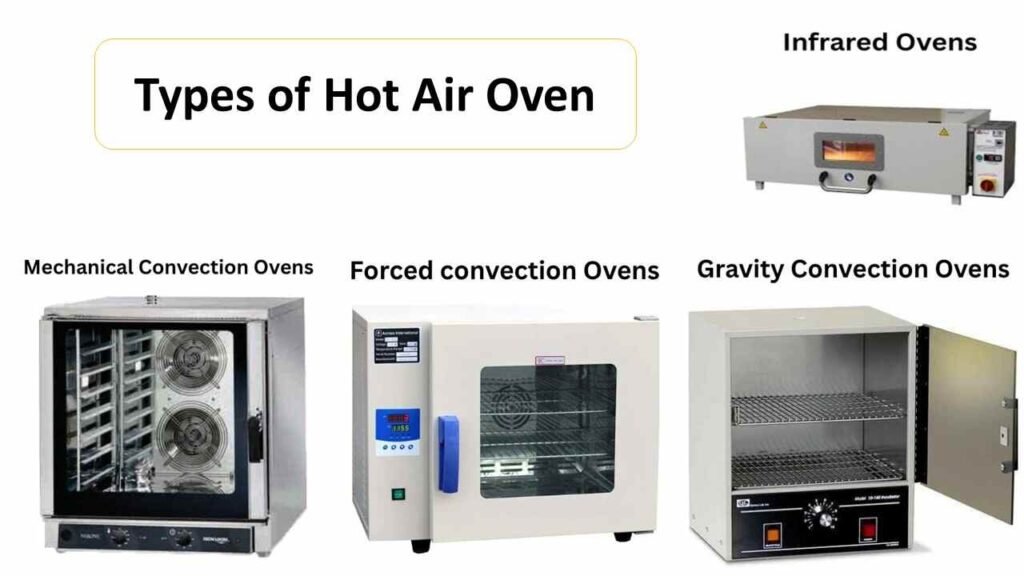
1. Forced convection Ovens
The most prevalent kind of hot air oven is the forced convection oven. Forced convection ovens, which use a fan to circulate hot air throughout the oven, provide a uniform temperature distribution for applications requiring quick and constant heating, such as sterilization and drying.
2. Gravity Convection Ovens
Gravity convection ovens, sometimes known as natural convection ovens, circulate heat through the natural motion of air. Instead of using a fan, they rely on the principle that hot air rises while cool air descends. Gravity convection ovens are cheaper than forced convection ovens, but they do not offer the same degree of temperature control.
3. Mechanical Convection Ovens
Industries commonly utilize vacuum ovens in situations where they need to dry or heat samples or materials at low pressure, such as in the electronics and aerospace industries, where moisture-sensitive components are present.
5. Infrared Ovens
Infrared ovens heated objects using infrared radiation. The food business commonly utilizes it to cook and dry food products, as well as the electronics sector to cure coatings and adhesives.
Applications of Hot Air Oven
- It is used to sterilize glassware, metal tools, and certain chemicals in powder, oil, and fat forms.
- Materials that are appropriate for sterilization in the instrument include: Glassware includes Petri plates, test tubes, flasks, pipettes, and syringes. Petri dishes made of glass or aluminum (not plastic dishes).
- Tubes made of glass (rimless) and bottles with aluminum caps or non-absorbent cotton wool stoppers.
- Autoclave is also appropriate for bottles.
- Glass flasks and cylinders (cover the open end with aluminum foil or paper, secured with string).
- Glass pipettes (graduated and Pasteur) with ends plugged to a depth of around 20mm with non-absorbent cotton wool.
- Metal instruments include forceps, scalpels, and scissors.
- Chemicals include powders, oils, fats, and petroleum jelly.
- Pharmaceutical products include liquid paraffin, fats, and grease. It can also be utilized at lower temperatures (80-100°C) to dry typical glassware.
Advantages of Hot Air Oven
- Because the equipment uses dry heat, sterilization does not need water. However, water is necessary for moist heat sterilization.
- While using this sterilizing procedure, bacterial endotoxin inactivation occurs. Oils and powders can only be sterilized in a hot air oven.
- They cannot be sterilized in an autoclave since clumps may form due to moisture.
- Noncorrosive to metals and sharp objects.
- Simple to install and has a low operating cost.
Disadvantages of Hot Air Oven
- Not effective against prions and some spores.
- Plastic and rubber cannot be sterilized due to high heat.
- May cause glassware discoloration.
- Takes longer than moist heat sterilization methods.
- Not suitable for surgical dressings and heat-sensitive materials.
Precautions When Using a Hot Air Oven
- Use only dry materials for sterilization.
- Never place flammable or volatile substances.
- Do not overcrowd the chamber.
- Allow air circulation for effective heating.
- Let the oven cool down before opening to prevent breakage.
Limitations of Hot Air Oven
- Ineffective on prions and highly heat-resistant spores.
- Can damage low-melting materials like plastics.
- Slower than alternatives like autoclaving, chemical, or radiation sterilization.
- Not all materials are compatible with dry heat.
Conclusion
A hot air oven is an indispensable tool for dry heat sterilization in laboratories. While it offers several benefits such as non-corrosiveness and cost-effectiveness, it also has limitations. Proper usage, handling, and understanding of its components ensure maximum effectiveness and safety in sterilization protocols.
Also Read
Reference and Sources
- www.testronixinstruments.com/blog/uses-of-hot-air-ovens-in-laboratories/
- https://applianceupdate.com/where-is-the-fan-on-a-refrigerator
- https://www.slideshare.net/VedGharat/hot-air-oven-pptx
