
Introduction
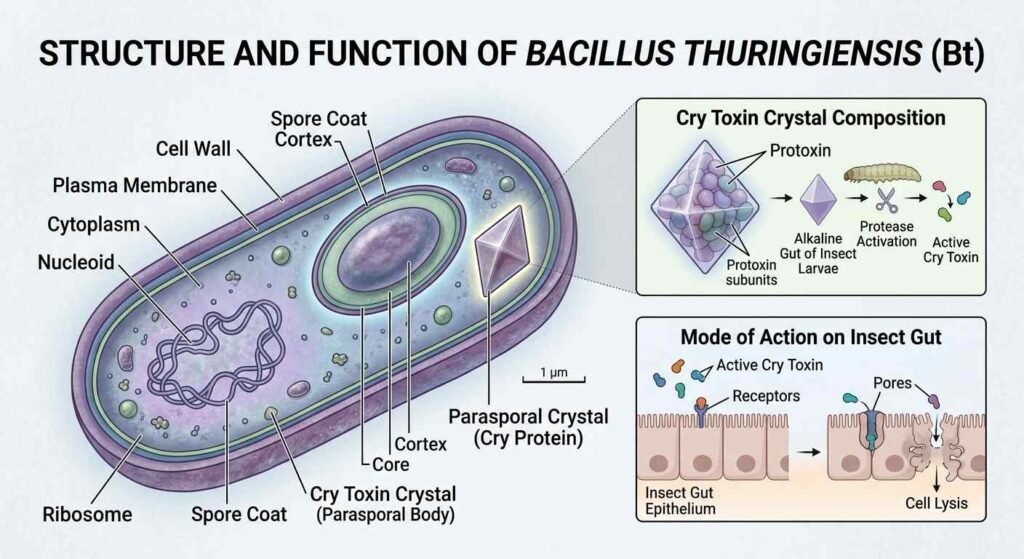
Bacillus thuringiensis (Bt) is a Gram-positive, rod-shaped, aerobic, spore-forming bacterium widely recognized for its powerful insecticidal properties. Scientists and agricultural experts use Bt extensively as a biological pesticide because it produces protein toxins that specifically target insect pests.
During sporulation, Bt synthesizes crystalline protein inclusions known as Cry and Cyt toxins. These toxins exhibit highly selective toxicity toward certain insect groups, making Bt one of the safest and most environmentally friendly pest control agents.
Modern biotechnology also uses Bt genes in genetically modified (GM) crops such as cotton, maize, and brinjal to provide built-in insect resistance.
Taxonomy and Classification
- Kingdom: Bacteria
- Phylum: Firmicutes
- Class: Bacilli
- Order: Bacillales
- Family: Bacillaceae
- Genus: Bacillus
- Species: Bacillus thuringiensis
Closely Related Species
Bt belongs to the Bacillus cereus group, which includes:
- Bacillus cereus
- Bacillus anthracis
Although these species share genetic similarities, Bt differs due to plasmids that encode insecticidal crystal proteins.
Historical Background
Scientists first discovered Bacillus thuringiensis in 1911 when Ernst Berliner isolated it from diseased flour moth larvae in Thuringia, Germany. Researchers later identified its insecticidal properties and began using it globally as a biological control agent in agriculture and vector management.
Natural Habitat
Bt exists naturally in diverse environments, including:
- Soil
- Leaf surfaces (phyllosphere)
- Stored grains
- Dead insect bodies
- Water and sediments
Its widespread presence supports a natural cycle of infection in insect populations.
Morphology and Colony Characteristics
Morphology
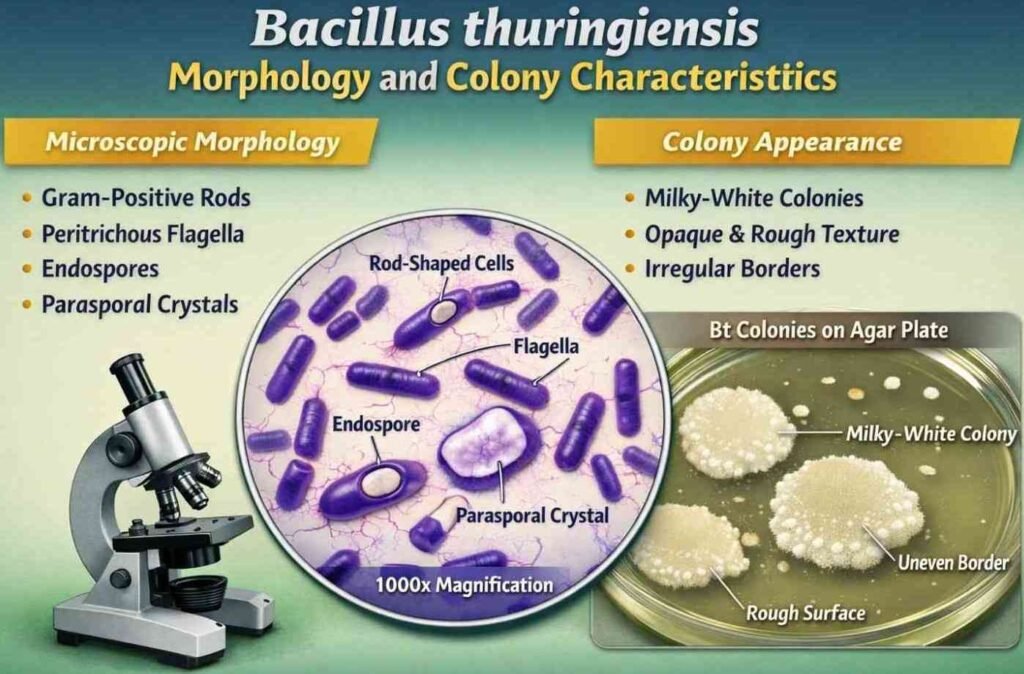
Bacillus thuringiensis shows the following structural features:
- Gram-positive rod-shaped cells.
- Motility due to peritrichous flagella.
- Ability to form endospores.
- Presence of parasporal crystalline inclusions (Cry proteins).
These crystals form adjacent to spores and serve as the key insecticidal component.
Colony Characteristics
When cultured in laboratory media, Bt produces:
- Milky-white, opaque colonies.
- Rough texture.
- Irregular or uneven margins.
Growth Conditions
- Optimal temperature: 28–37°C.
- Oxygen requirement: Aerobic or facultative anaerobic.
- Special feature: Crystal formation occurs during sporulation.
Physiology
- Under nutrient-rich circumstances, Bt reproduces vegetatively, but it sporulates when nutrients are scarce.
- The creation of crystal toxins takes place throughout sporulation.
- Due to safety issues, commercial formulations are not allowed to include β-exotoxins, which are thermostable, broad-spectrum insecticidal substances produced by certain strains.
Toxins Produced by Bacillus thuringiensis
Bt produces multiple toxin types, each targeting specific insect groups:
| Toxin Type | Produced During | Target Insects | Characteristics |
| Cry (Crystal) | Sporulation | Lepidoptera, Diptera, Coleoptera | Bind to gut receptors and form pores |
| Cyt (Cytolytic) | Sporulation | Mainly Diptera | Destroy gut epithelial membranes |
| Vip (Vegetative Insecticidal Proteins) | Vegetative growth | Lepidoptera & others | Secreted, do not form crystals |
| Sip (Secreted Insecticidal Proteins) | Vegetative growth | Coleoptera | Less common |
Mechanism of Insecticidal Action
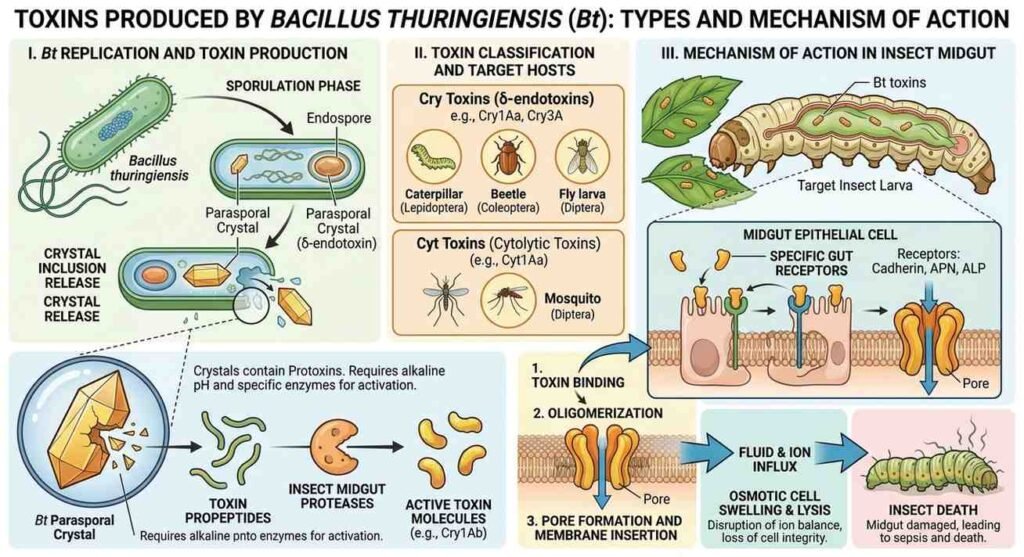
- Consumption of Bt-foods or sprayed leaves by insect larvae.
- The alkaline midgut of insects causes crystal proteins to dissolve.
- Gut proteases trigger the activation of protoxins.
- The active poison interacts with certain receptors on the cells lining the intestine.
- Mid-gut lining pores develop, resulting in:
- Cellular integrity loss
- Gut paralysis
- End of feeding
- Bt spores germinate and penetrate the hemocoel of insects.
- Results in septicemia and the demise of the insect.
Subspecies of Bt and Their Targets
| Subspecies | Major Target Pests |
| Bt kurstaki | Caterpillars (Lepidoptera) – e.g., cotton bollworm, cabbage worm |
| Bt israelensis | Mosquito and blackfly larvae (Diptera) |
| Bt tenebrionis / Bt morrisoni | Beetles (Coleoptera) |
| Bt aizawai | Armyworms, diamondback moth |
| Bt galleriae | Wax moth larvae |
Uses in industry and agriculture
A. Microbial Formulations (Bio-pesticides)
Bt is a key biological control agent used in:
- Organic agriculture.
- Horticulture.
- Forestry pest management.
Forms of commercial Bt:
- Powders that may be wetted.
- Granules.
- Liquid mixtures.
- Sprays from the air.
- Mosquito-killing pellets.
Benefits:
- Very particular to pests.
- Environmentally friendly and biodegradable.
- The least possible harm to people, animals, and helpful bugs.
B. Bt Genetic Modification
- Cry genes are implanted in plants like cotton, maize, brinjal, and potato.
- The inherent insect resistance of Bt plants lessens the demand for chemical insecticides.
Benefits:
- Increased yield.
- Less use of pesticides.
- Decreased environmental pollution.
Environmental Effects and Security
Safety to Humans and Animals:
- Insects are targeted by Bt because of their distinct gut pH and receptors that are absent in mammals.
- Considered safe for people, most non-target species, and animals.
Environmental Behavior:
- Although toxins break down in soil under sunlight and microbial action, Bt spores remain.
- Does not accumulate in living organisms.
Safety measures:
- Avoid commercial strains that produce β-exotoxin, which is harmful to non-target species and mammals.
Resistance Development in Insects
Continuous Bt exposure (especially in genetically modified Bt plants) may result in resistance.
Mechanisms of resistance:
- Changes in gut receptors.
- Enhanced protease activity in the intestines.
- Lowered toxin binding.
Techniques for Managing Resistance:
- Using refuge crops.
- The practice of combining several Cry genes is known as gene stacking.
- Changes in Bt strains and alternative biopesticides.
Advantages of Bacillus thuringiensis
- Eco-friendly pest control.
- High specificity.
- Reduces chemical pesticide dependence.
- Improves agricultural sustainability.
- Supports integrated pest management (IPM).
Limitations
- Slower action compared to chemical pesticides.
- Limited effectiveness against non-target insects.
- Resistance development risk.
- Requires proper application timing.
Future Prospects
Researchers continue to explore advanced Bt applications, including:
- Development of next-generation Bt toxins
- Improved GM crops
- Combination with nanotechnology
- Use in integrated pest management systems
Bt remains a cornerstone of sustainable agriculture and biotechnology.
Conclusion
Bacillus thuringiensis plays a crucial role in modern agriculture as a safe, effective, and environmentally friendly biological pesticide. Its ability to produce highly specific insecticidal toxins makes it superior to many chemical alternatives.
The integration of Bt in microbial formulations and genetically modified crops has revolutionized pest management by increasing productivity and reducing environmental damage. However, proper resistance management strategies must be implemented to maintain its long-term effectiveness.
Overall, Bt continues to be a vital tool in sustainable agriculture, offering a balance between productivity and ecological safety.
Frequently Asked Questions (FAQs)
Q1. What is Bacillus thuringiensis?
Bacillus thuringiensis is a soil bacterium that produces toxins harmful to specific insects and is widely used as a biological pesticide.
Q2. How does Bt kill insects?
Bt toxins disrupt the insect gut lining by forming pores, leading to paralysis and death.
Q3. Is Bt safe for humans?
Yes, Bt is safe because humans lack the gut conditions and receptors required for toxin activation.
Q4. What are Bt crops?
Bt crops are genetically modified plants that contain Bt genes, allowing them to resist insect pests naturally.
Q5. What are Cry proteins?
Cry proteins are crystal toxins produced during sporulation that specifically target insect gut cells.
Q6. Can insects develop resistance to Bt?
Yes, insects can develop resistance over time, which is why strategies like refuge crops and gene stacking are important.
Q7. Where is Bt found naturally?
Bt is commonly found in soil, water, plant surfaces, and insect bodies.
Q8. What are the advantages of Bt over chemical pesticides?
Bt is eco-friendly, target-specific, biodegradable, and safer for humans and beneficial organisms.
Reference and Sources
- https://pmc.ncbi.nlm.nih.gov/articles/PMC5591175/
- https://www.frontiersin.org/journals/microbiology/articles/10.3389/fmicb.2025.1518307/full
- https://www.researchgate.net/publication/370252500_Bacillus_thuringiensis_a_natural_endophytic_bacterium_found_in_wild_plants
- https://www.ncbi.nlm.nih.gov/datasets/taxonomy/1428/
- https://testbook.com/biology/bacillus-thuringiensis-notes
- https://nsuniv.ac.in/wp-content/uploads/2025/03/Bacillus.pdf
- https://imskolkata.org/article1/002-01-20.pdf
- https://pmc.ncbi.nlm.nih.gov/articles/PMC3035146/
- https://www.britannica.com/science/Bacillus-thuringiensis
- https://www.researchgate.net/publication/318152732_Bacillus_thuringiensis_Characterization_Morphology_Physiology_Biochemistry_Pathotype_Cellular_and_Molecular_Aspects
Also Read
- Gram staining
- Agriculture Microbiology
- Beneficial Bacteria in Human Gut: An Overview
- Ethanol : production, recovery and uses
- Proteus Bacilli: Introduction, Morphology, Biochemical and Treatment
- Probiotics: Benefits for Your Gut Health
- HACCP and Food Safety Standards: Principles, Steps, FSMS & FSSAI Guide
- Application of Microbiology in Daily Life: Examples, Uses & Importance
