
Introduction
Plant pathology is the science of diagnosing and managing plant diseases caused by a variety of agents such as fungi, bacteria, viruses, nematodes, and even environmental stressors. This crucial discipline plays a vital role in agriculture, horticulture, and forestry by protecting crops and ensuring global food security.
What Is Plant Pathology?
Plant pathology, or phytopathology, is the study of plant diseases and the biological or environmental factors that cause them.
These may include:
- Pathogens like fungi, bacteria, viruses, and nematodes
- Environmental factors such as pollution, nutrient deficiencies, or extreme weather
The goal is to understand how plant diseases develop, spread, and affect crop health—while developing sustainable control strategies to minimize damage and maximize yield.
Key Figures in Plant Pathology
| Scientist | Year | Discovery |
| Heinrich Anton de Bary | 1831–1888 | Known as the father of plant pathology; he demonstrated that fungi cause plant diseases. |
| E. J. Butler | 1874–1943 | Considered the father of Indian plant pathology; he worked extensively on fungal diseases of crops in India. |
| M. J. Thirumalachar | 1914–1999 | An Indian mycologist and plant pathologist, known for research on fungal diseases and antibiotics from fungi. |
| Norman E. Borlaug | 1914–2009 | Although better known as a plant breeder and the “father of the Green Revolution,” he had a strong background in plant pathology. |
| Arthur Henry Reginald Buller | 1874–1944 | Famous for work on fungal reproduction and spore discharge. |
| George N. Agrios | 1936–2009 | Author of the widely used textbook Plant Pathology. |
| Charles E. Palm | 1911–1996 | Renowned for work in disease management and plant protection policies. |
| C. V. Subramanian | 1924–2016 | Indian mycologist who worked on the taxonomy of Hyphomycetes. |
| B. B. Mundkur | 1896–1952 | Pioneered plant pathology and mycology research in India, particularly on rust diseases. |
| T. S. Sadasivan | 1913–2001 | Worked on the physiology of host-pathogen interactions and fungal diseases. |
Importance of plant pathology
- Food security→ Protecting crops from diseases through plant pathology ensures consistent food production and lowers the chance of famine.
- Improved crop yield and quality→ Farmers can increase their harvests and enhance the quality of their products by learning to handle plant diseases effectively.
- Economic benefits→ Saving crops from damage eliminates billions in losses worldwide and helps sustain farmers’ financial well-being.
- Sustainable agriculture→ Understanding plant ailments reduces the need for excessive pesticide use, fostering environmentally friendly farming practices.
- Protection of biodiversity→ Managing plant illnesses helps conserve native species and supports the stability of ecosystems.
- Support for global trade→ Healthy crops comply with international trade regulations, diminishing the risk of disease spread between countries.
- Advancement of scientific knowledge→ Research in plant pathology advances the fields of genetics, microbiology, biotechnology, and ecology.
Major plant diseases
1. Bacterial disease
- Exudations: In various bacterial illnesses, like the bacterial blight affecting rice and the fire blight seen in pome fruits, large groups of bacteria seep from the damaged part and show up on the outside as droplets or streaks.
- Necrosis: This refers to the death of body tissues and organs due to the presence of parasites. The signs of necrosis can be quite different.
- Wilts: This is when whole plants become dry or wilted. The leaves and other soft green parts lose their firmness, becoming limp and hanging down.
- Galls: Galls are unusual growths of plant tissue that occur as a reaction to damage or irritation, often (but not always) caused by some living organism. Organisms like nematodes, bacteria, fungi, and viruses can lead to the development of galls on trees, shrubs, and other plant.
2. Fungal disease
- Mildews: Patches of different colors like white, gray, brown, or purple can appear in various sizes on leaves, non-woody stems, or fruit.
- Powdery Mildew: Leaves affected by powdery mildew show a white, dusty layer on leaves, stems, and flowers. A fungus is responsible for this condition, impacting many plants such as lilacs, apples, grapes, cucumbers, peas, phlox, daisies, and roses.
- Downy Mildew: Organisms similar to fungi bring on downy mildew and can harm various ornamental plants and edible crops like broccoli and cauliflower. It typically appears during rainy weather, leading to a change in color on the upper surface of leaves, while white or gray mold covers the underside.
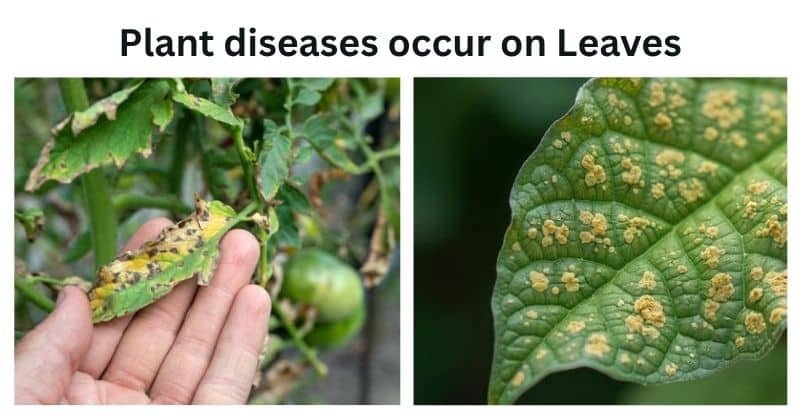
- Rusts: Small pustules of spores can form, often breaking through the outer layer of the plant.
- White Blisters: These look like white pustules that open up to reveal a powdery spore mass inside.
- Scab: Scab indicates a rough or crest-like mark or a freckled look on the affected part of the plant.
- Smuts: In plants affected by smuts, the damaged areas present a purplish-black or black powdery mass.
- Fruiting Bodies: These are large, fleshy or woody structures that produce spores, formed by wood-decomposing fungi.
- Mosaic: Virus Multiple mosaic viruses exist, but gardeners generally come across two main types: tomato mosaic virus and tobacco mosaic virus. The former affects tomatoes, peppers, potatoes, apples, pears, and cherries; the latter targets tomatoes, peppers, cucumbers, lettuce, beets, petunias, and, of course, tobacco.
- Black Spot: Black spot is a common fungal condition seen on roses as well as other flowers and fruits. While it does not kill the plants directly, it weakens them and makes them more vulnerable to other issues. In cool and moist weather, small black dots appear on leaves, which then turn yellow and eventually fall off.
- Damping-Off Disease: Damping-off disease is caused by various fungi found in the soil, and it is most problematic in wet and humid places. It affects seedlings, causing them to wilt and decay. This issue frequently occurs in greenhouses but can also happen outside.
- Fusarium Wilt: A soil-borne fungus leads to fusarium wilt, which impacts both ornamental and edible plants like dianthus, beans, tomatoes, peas, and asparagus. The disease results in wilting leaves, stunted plants, root rot, and occasionally blackened stems. It is most active during hot summer conditions.
- Verticillium Wilt: Verticillium wilt is a fungal condition that targets many kinds of trees, shrubs, edible plants, and ornamental varieties. The fungi can survive in the soil for years, entering the plants through their roots, which eventually blocks the vascular system leading to sudden wilting of branches and premature yellowing and dropping of leaves. It may also hamper growth.
- Snow Mold: Snow mold is a fungal type that thrives in cold, moist conditions found just under the snow. It targets turf grass. Once the snow melts, visible signs appear: light tan patches of grass that have been matted down by fungal threads.
3. Viral disease
Plum pox virus: Plum pox virus (PPV) is responsible for the sharka illness in stone fruits such as plums, peaches, and apricots. This virus results in yellow leaves, misshapen fruits, early fruit loss, and lower harvest amounts. It is transmitted by infected plants and aphids. To manage it, one should use plants that are free of the virus, eliminate infected trees, and control aphid populations.
Disease Cycle in Plants
- For a disease to occur, it is essential that a pathogen is present and effectively invades the tissues and cells of the plant host.
- The process that leads to disease development consists of several stages: inoculation, penetration, infection, incubation, reproduction, and survival.
1. Inoculation
- This refers to the process of introducing the plant pathogen to its host.
- Various groups of pathogens use different methods of inoculation and have specific mechanisms that assist in this process.
- For instance, some types of fungal pathogens release spores into the air, which are carried away by wind currents.
2. Penetration
- Some plant pathogens can enter through wound areas and natural openings in plants like stomata; meanwhile, others have developed special ways to penetrate directly.
- Fungi and nematodes can actively invade host tissues and cells when the surrounding conditions, including moisture and temperature, are suitable for the penetration to occur.
3. Infection
- This stage happens when the pathogen infiltrates the plant tissue and forms a parasitic connection with the plant.
- Viruses, bacteria, and phytoplasmas cannot actively penetrate or enter plant tissues.
- Thus, they need to use other means to infect the cells and tissues of the plant.
4. Incubation
- After entering the plant, pathogens can enter an incubation stage, remaining inactive for a while before starting the disease.
5. Reproduction
- Plant pathogens have the ability to reproduce in two ways: sexually and asexually.
- The type of reproduction used depends on the specific pathogen.
- There are three key phases in the relationship between host and pathogen.
These phases are:
- Pre-Penetration Phase
- Penetration Phase
- Post-Penetration Phase
1. Pre-Penetration Stage
- During the pre-penetration stage, when disease-causing organisms come into contact with the host’s outer layer, they engage with both the host itself and its surroundings. Here, elements such as temperature, moisture, light, and other microorganisms play a crucial role in their ability to survive. Substances released by the host, including sugars and amino acids, may promote the growth of pathogens.
- Conversely, certain agents like hydrocyanic acid, organic acids, antibiotics, and antifungal substances can hinder their development. For pathogens to endure, they must be able to withstand or counteract these protective measures. Moreover, the microbes present in the rhizosphere can limit the growth of pathogens; however, once a pathogen manages to adjust successfully to the host’s surface, it quickly begins to reproduce.
2. Penetration Stage
- The process by which a pathogen successfully invades a host is intricate, shaped by the pathogen’s ability to reproduce, the environment, and how vulnerable the host is. The capacity of the inoculum is key for colonization and depends on factors such as its concentration, nutrients present, environmental factors (15–25°C, about 70% moisture, and 90–95% humidity), its strength, and the host’s weaknesses.
- The likelihood of a host becoming infected is influenced by aspects like age, stress from the environment, previous infections, and contact with chemicals. Pathogens can enter through natural openings (like stomata, lenticels, or hydathodes), through injuries (caused by weather, insects, or farming activities), by directly penetrating surface cells (with help from moisture, enzymes, and pressure), or by targeting specific parts of the host (like stems, roots, or buds).
- Generally, bacteria and viruses enter through injuries, while fungi usually exploit natural openings and use enzymes to break down components of the cell walls, such as pectin, cellulose, and lignin.
3. Post penetration stage
- After a pathogen manages to invade plant tissue, the nature of the infection and disease depends on the interaction between the host and the pathogen. The host can respond in multiple ways: elevated enzyme levels increase respiration, resulting in the accumulation of phenols and the deterioration of ATP. Furthermore, the breakdown of chlorophyll can interfere with photosynthesis and may occasionally lead to chlorosis, also known as “green islands.”
- Hormonal disruptions can upset regular growth, leading to problems like strange growth shapes, premature ripening, or the shedding of leaves, flowers, and fruits. The development of reproductive structures may either fail or get harmed. Water movement is obstructed due to xylem clogs, formation of tyloses, actions of pectic enzymes, and what are known as “wilt toxins,” which hinder water flow.
- The function of lytic enzymes can cause tissue misalignment by degrading cell walls and resulting in protoplast death. These disturbances lead to abnormal growth patterns and damage to tissue, as the pathogen produces enzymes that break down cell walls, including cellulases and pectinases.
How Pathogens Spread ?
Pathogens can be transmitted in two ways: directly and indirectly.
- Direct transmission of pathogens happens through seeds, organs, or other plant parts.
- Seeds: Infected seeds serve as the main source of plant infections caused by certain viruses, bacteria, and various fungi and fungus-like organisms.
- Vegetative Organs: Organs that reproduce vegetatively and come from plants affected systemically, especially by bacteria and viruses.
- Thus, all viruses present in the plant organs used for propagation through grafting, budding, planting as seedlings, bulbs, or rhizomes can be spread.
Factors that facilitate spread of pathogens
The indirect transmission of disease-causing agents is often aided by several elements:
- Air movements: Diseases spread through air currents are generally the most significant contributors to an outbreak.
- Moving water and rainfall: Moving water can transfer spores from fungus-like organisms. Rain disperses mitospores.
- Animals: For instance, thrushes spread mistletoe seeds. Flies and mosquitoes carry spores. Bees and flies transport pollen. Several types of aphids and jumpers with piercing and sucking mouthparts transmit viruses.
- Humans: Disease agents are spread by people through buying and selling farm products and performing caregiving tasks.
- Infection and contamination: When decayed material holds or transmits infectious parts of a disease agent, it becomes contaminated. Contamination can also refer to the presence of toxic materials. It signifies a loss of cleanliness. Inanimate matter cannot be infected. Living organisms can be contaminated and made sick. Infected items contain a pathogen.
- Monocyclic pathogens: These are agents that complete their cycle of disease within one year or part of it.
- Polycyclic pathogens: These pathogens can produce multiple generations of infectious agents in one growing season. The number of generational cycles in this category can be between 2 and 30 throughout the year. Hence, the quantity of inoculum generated increases with every cycle and grows considerably over time.
Disease Management Strategies
- Cultural methods → Techniques such as rotating crops, maintaining cleanliness, and ensuring correct plant spacing lower the chances of pathogens living and spreading.
- Resistant varieties → Growing crops that are resistant or tolerant to diseases helps avoid significant outbreaks.
- Chemical and biological control → Farmers utilize chemicals like fungicides, insecticides, and helpful microbes thoughtfully to control diseases within a comprehensive approach.
Conclusion
- Plant pathology is an important field that protects worldwide farming by studying and controlling plant diseases caused by different pathogens such as fungi, bacteria, viruses, and nematodes, along with environmental pressures. By examining how diseases develop, transmit, and can be managed, researchers in plant pathology enhance not just crop production and quality but also contribute to food security, economic health, biodiversity protection, and sustainable agricultural methods.
- As issues like climate change and rising populations escalate, the significance of plant pathology is crucial for maintaining healthy crops, expanding scientific understanding, and encouraging environmentally-friendly farming techniques.
Reference and Sources
- Plant Pathology by George N. Agrios
- FAO Plant Health Resources: fao.org/plant-health
Also Read
- Bioremediation: Definition, Types, Process and Application
- Trichoderma: Overview, Mechanism of Action and Applications
- Introduction of Plant-Microbe Association and the Mycorrhizae
- Delta Variant: Introduction, Transmission Rate, Symptoms and vaccination
- Antimicrobial activity of Mimosa pudica l
- Overview of an antimicrobial agents
- Overview of the Bacterial Pathogenesis
- Phosphate & potassium solubilizing bacteria as PGPR
