
Crassulacean Acid Metabolism (CAM) Pathway: Complete Explanation
Introduction
The Crassulacean Acid Metabolism (CAM) pathway is a specialized photosynthetic adaptation that allows plants to survive in extremely dry and arid environments. This pathway enables plants to conserve water while efficiently fixing carbon dioxide (CO₂), making it a crucial survival strategy in desert ecosystems.
Plants that use the CAM pathway, such as cacti and succulents, open their stomata at night instead of during the day. This unique behavior reduces water loss caused by evaporation under high temperatures.
The CAM pathway represents an advanced evolutionary solution to environmental stress, especially in regions where water availability limits plant growth.
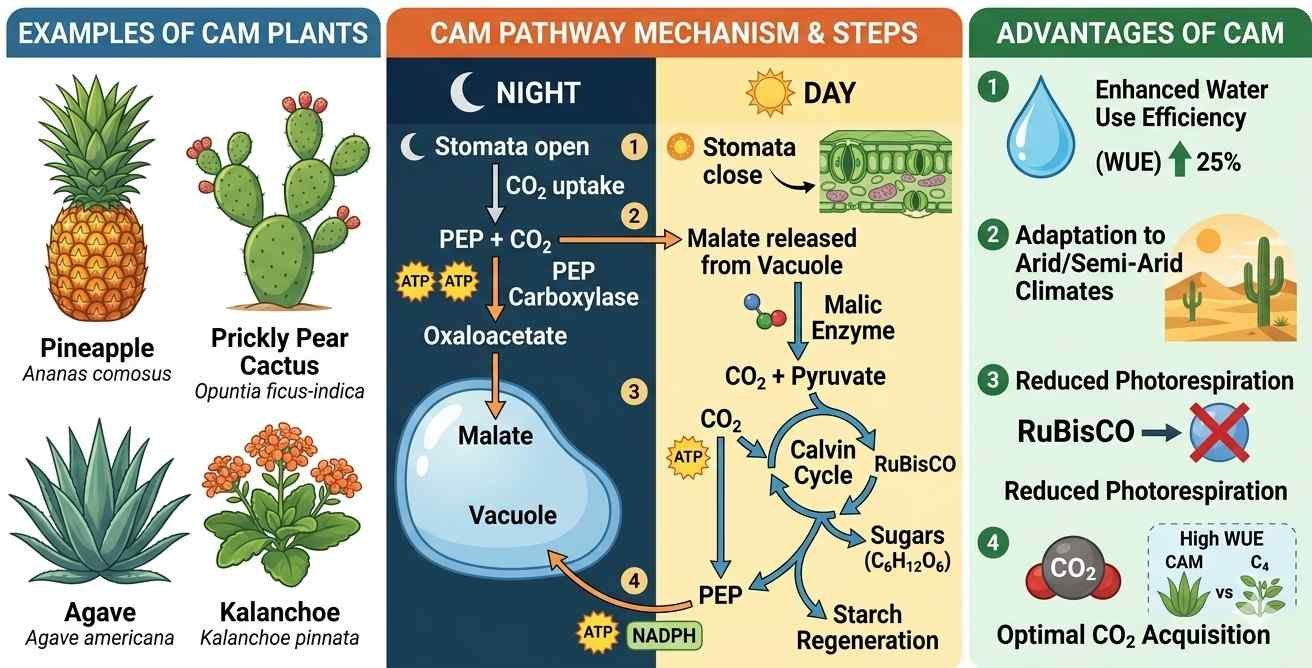
What is the CAM Pathway?
- The CAM pathway is a temporal separation photosynthesis mechanism, where plants fix CO₂ at night and perform the Calvin cycle during the day.
- Unlike C3 and C4 plants, CAM plants:
- Open stomata at night.
- Store CO₂ in the form of organic acids.
- Release CO₂ during the day for photosynthesis.
- This strategy significantly reduces transpiration and improves water-use efficiency.
Key Feature: Temporal Separation
The CAM pathway separates photosynthesis into two phases:
Night (Dark Phase)
- Stomata open.
- CO₂ enters the plant.
- CO₂ converts into organic acids (malate).
Day (Light Phase)
- Stomata close.
- Stored CO₂ releases.
- Calvin cycle occurs.
This day-night separation is the defining feature of CAM plants.
Steps of the CAM Pathway
The CAM pathway involves a cyclic sequence of biochemical reactions divided into night and day processes.
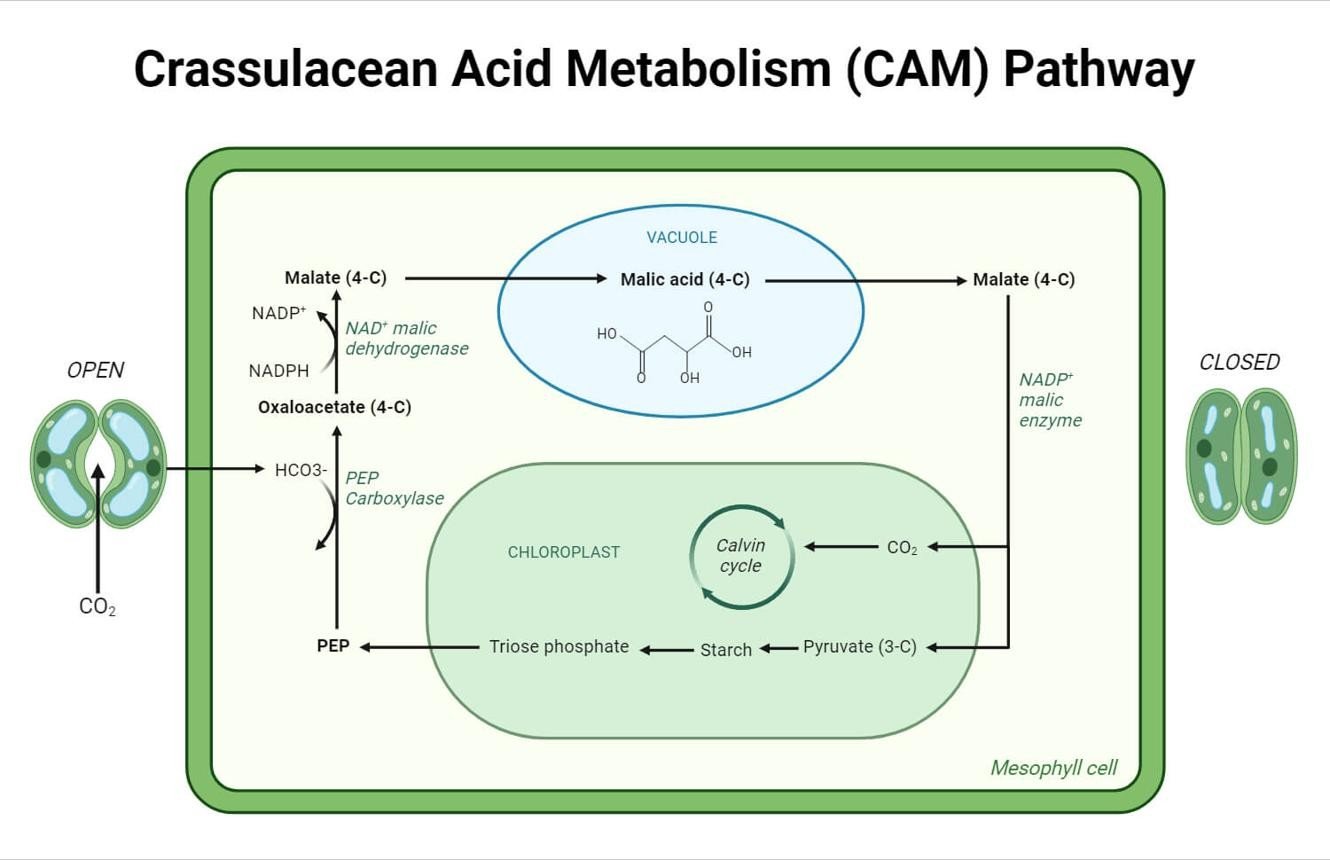
Night Phase (CO₂ Fixation)
Step 1: CO₂ Uptake
- Plants open stomata at night.
- CO₂ diffuses into mesophyll cells.
Step 2: Formation of Bicarbonate
- CO₂ converts into bicarbonate (HCO₃⁻) using carbonic anhydrase.
Step 3: Fixation by PEP Carboxylase
- PEP carboxylase (PEPC) fixes bicarbonate.
- Forms oxaloacetate (OAA), a 4-carbon compound.
Step 4: Formation of Malate
- Oxaloacetate converts into malate
- Malate stores in vacuoles as malic acid
This storage gives CAM plants their name (acid accumulation).
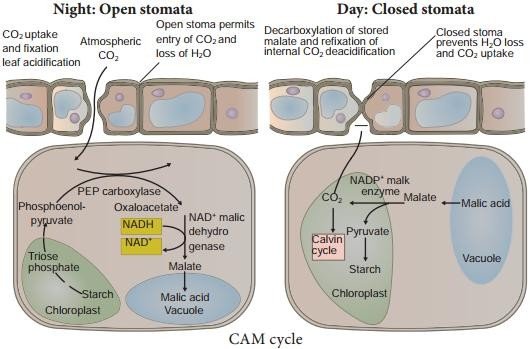
Day Phase (CO₂ Release and Calvin Cycle)
Step 5: Stomatal Closure
- Stomata close during the day.
- Prevent water loss.
Step 6: Decarboxylation
- Malic acid breaks down.
- Releases CO₂ inside cells.
Step 7: Calvin Cycle
- Released CO₂ enters the Calvin cycle.
- RuBisCO fixes CO₂ efficiently.
- Produces glucose and sugars.
Biochemical Mechanism Summary
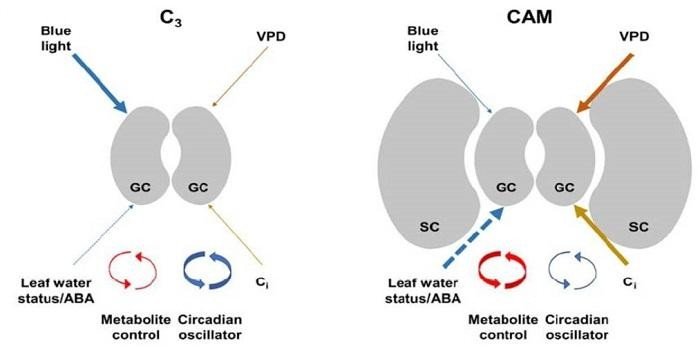
The Crassulacean Acid Metabolism (CAM) pathway operates through a time-separated (temporal) biochemical mechanism. Plants divide carbon fixation and the Calvin cycle between night and day, which allows them to conserve water while maintaining photosynthesis.
The mechanism involves four major phases (Phase I–IV) that occur in a 24-hour cycle.
- Phase I: Night – CO₂ Uptake and Fixation.
- Phase II: Early Morning – Transition Phase.
- Phase III: Day – Decarboxylation and Calvin Cycle.
- Phase IV: Late Afternoon – Regeneration of PEP.
- Night: CO₂ → HCO₃⁻ → OAA → Malate → Stored as malic acid.
Day: Malic acid → Malate → CO₂ release → Calvin cycle → Sugar formation.
This mechanism ensures efficient photosynthesis with minimal water loss.
Enzymes Involved in CAM Pathway
| Enzyme | Function |
| Carbonic anhydrase | Converts CO₂ to bicarbonate |
| PEP carboxylase (PEPC) | Fixes CO₂ at night |
| Malate dehydrogenase | Converts OAA to malate |
| Malic enzyme | Releases CO₂ during the day |
| RuBisCO | Fixes CO₂ in Calvin cycle |
| Pyruvate phosphate dikinase (PPDK) | Regenerates PEP |
Energy Requirement of CAM Pathway
- CAM pathway requires ATP for PEP regeneration.
- Energy demand is similar to C4 plants.
- However, CAM plants optimize:
- Water conservation.
- Carbon fixation efficiency.
Biochemical Features of CAM Pathway
- Temporal separation of carbon fixation and Calvin cycle.
- Night-time acid accumulation (malic acid storage).
- Daytime decarboxylation and sugar synthesis.
- High internal CO₂ concentration.
- Minimal photorespiration.
Examples of CAM Plants
- CAM plants typically grow in arid and semi-arid environments.
- Common Examples:
- Cactus
- Pineapple
- Aloe vera
- Agave
- Kalanchoe
- These plants show thick leaves, reduced surface area, and water-storing tissues.
Types of CAM Pathway
1. Obligate CAM Plants
- Always use CAM pathway.
- Example: cactus.
2. Facultative CAM Plants
- Switch between C3 and CAM.
- Example: some orchids.
3. CAM Cycling Plants
- Partially use CAM.
- Recycle internal CO₂.
Ecological Significance
The CAM pathway plays a vital role in:
- Desert ecosystems.
- Water conservation.
- Climate adaptation.
Key Benefits:
- High water-use efficiency.
- Survival in extreme drought.
- Reduced transpiration.
- Adaptation to high temperatures.
Applications of CAM Pathway
- CAM plants serve as models for developing crops that can survive water scarcity.
- CAM plants tolerate extreme environments, making them important for future agriculture.
- Many CAM plants are used in landscaping due to their aesthetic value and low water requirement.
- CAM plants contribute to carbon storage in dry ecosystems.
- CAM plants reduce irrigation demand and support sustainable farming practices.
Advantages of CAM Pathway
- Minimizes water loss.
- Reduces transpiration.
- Improves water-use efficiency.
- Allows survival in deserts.
- Efficient carbon fixation under stress.
Limitations of CAM Pathway
- Slower growth rate.
- Limited CO₂ uptake capacity.
- Requires specialized storage mechanisms.
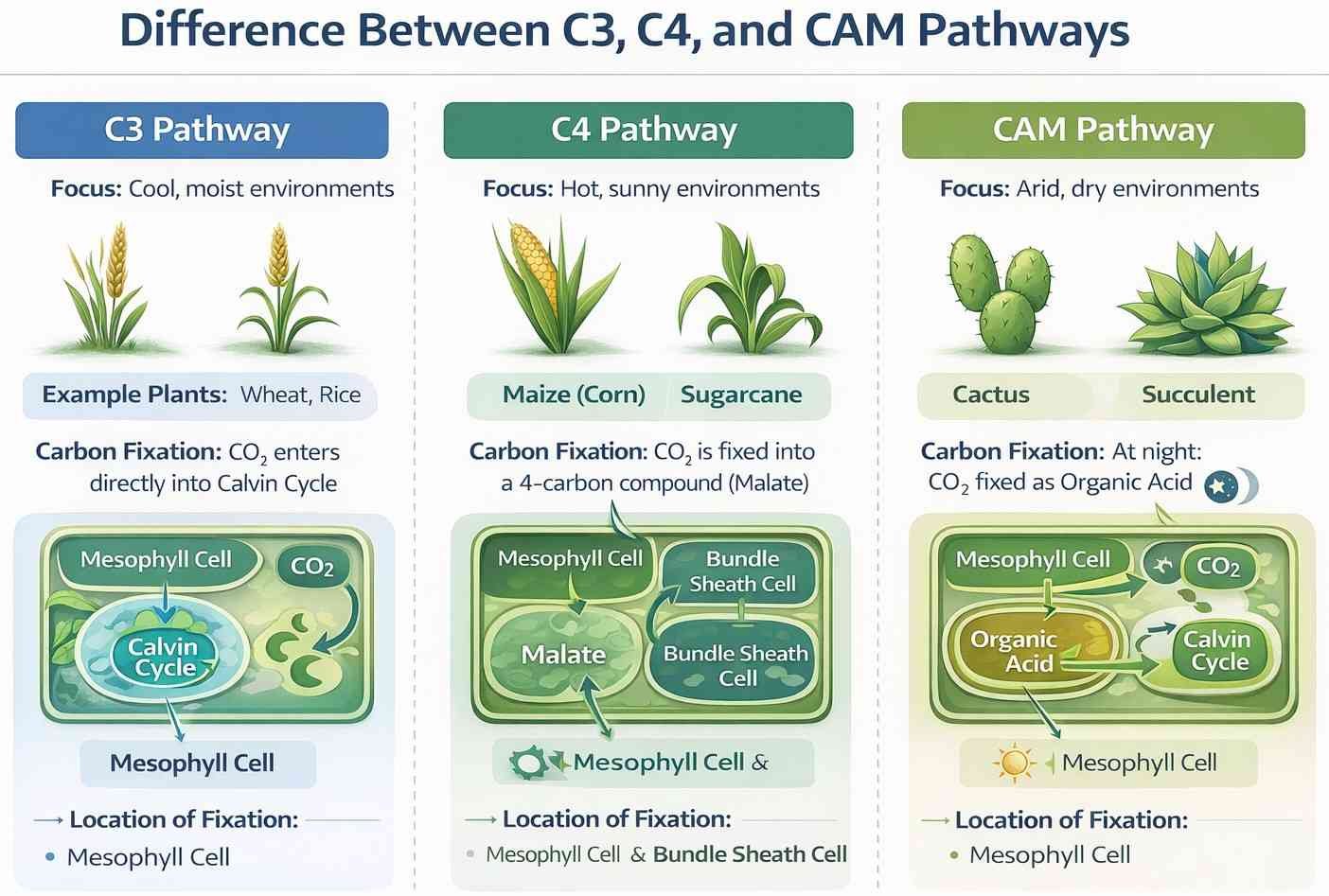
Difference Between C3, C4, and CAM Pathways
| Feature | C3 | C4 | CAM |
| CO₂ Fixation | Day | Day | Night |
| Photorespiration | High | Low | Very Low |
| Water Loss | High | Moderate | Very Low |
| Adaptation | Moderate climates | Tropical | Desert |
Conclusion
The Crassulacean Acid Metabolism (CAM) pathway represents one of the most efficient survival strategies in plant biology. It allows plants to conserve water while maintaining photosynthesis under extreme environmental conditions.
By separating CO₂ fixation and the Calvin cycle into night and day phases, CAM plants reduce water loss and enhance survival in arid regions. Although this pathway limits growth speed, it provides unmatched advantages in drought resistance and ecological stability.
As climate change intensifies, researchers continue to explore CAM mechanisms to develop drought-resistant crops and improve agricultural sustainability. The CAM pathway highlights how plants adapt their metabolism to survive and thrive in challenging environments.
Frequently Asked Questions (FAQ)
Q1. What is the CAM pathway?
The CAM pathway is a photosynthetic process where plants fix CO₂ at night and perform photosynthesis during the day.
Q2. Why do CAM plants open stomata at night?
They open stomata at night to reduce water loss caused by daytime heat.
Q3. What is the main product stored in CAM plants?
Malic acid (malate) stores in vacuoles during the night.
Q4. Give examples of CAM plants.
Examples include cactus, pineapple, aloe vera, and agave.
Q5. How is CAM different from C4 pathway?
CAM separates processes by time, while C4 separates them by location.
Q6. Is CAM pathway energy efficient?
It is water-efficient but slower in growth compared to C3 and C4 plants.
Q7. Where does the Calvin cycle occur in CAM plants?
It occurs during the day using stored CO₂.
Q8. What type of environment favors CAM plants?
Dry, arid, and desert environments favor CAM plants.
Reference and Conclusion
- Taiz, L., Zeiger, E., Møller, I.M., & Murphy, A. (Plant Physiology and Development)
- Raven, P.H., Evert, R.F., & Eichhorn, S.E. (Biology of Plants)
- Nobel, P.S. (Physicochemical and Environmental Plant Physiology)
- FAO Reports on Climate-Resilient Crops
- Research articles on CAM photosynthesis (various plant physiology journals)
- https://www.geeksforgeeks.org/biology/c3-and-c4-photosynthetic-pathways/
- https://pmc.ncbi.nlm.nih.gov/articles/PMC3075750/
Also Read
