
Introduction
The C4 pathway, also known as the Hatch–Slack pathway, is a specialized photosynthetic process that enables plants to survive and thrive in high temperature, intense light, drought, and low CO₂ conditions. Scientists discovered this pathway as an evolutionary adaptation that helps plants overcome the limitations of the traditional C3 pathway.
In normal photosynthesis, the enzyme RuBisCO sometimes reacts with oxygen instead of carbon dioxide. This process causes photorespiration, which reduces efficiency and wastes energy. The C4 pathway solves this problem by concentrating CO₂ around RuBisCO, ensuring efficient carbon fixation.
Plants such as maize, sugarcane, sorghum, and millets use this mechanism. These plants dominate tropical and subtropical regions due to their superior adaptability.
What is the C4 Pathway?
The C4 pathway is a two-cell photosynthetic mechanism involving:
- Mesophyll cells
- Bundle sheath cells
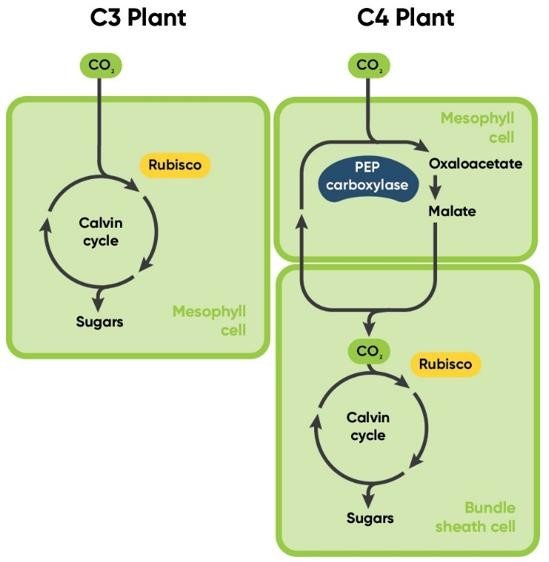
In this process, plants first fix CO₂ into a 4-carbon compound (oxaloacetate) instead of the 3-carbon compound formed in C3 plants. This unique feature gives the pathway its name: C4 (four-carbon) pathway.
This mechanism allows plants to:
- Minimize photorespiration.
- Increase photosynthetic efficiency.
- Improve water and nitrogen use efficiency.
Kranz Anatomy (Special Leaf Structure)
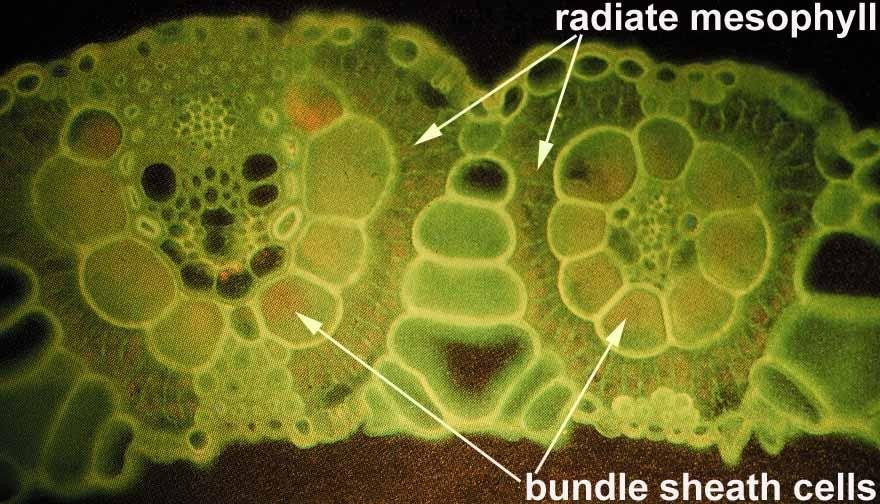
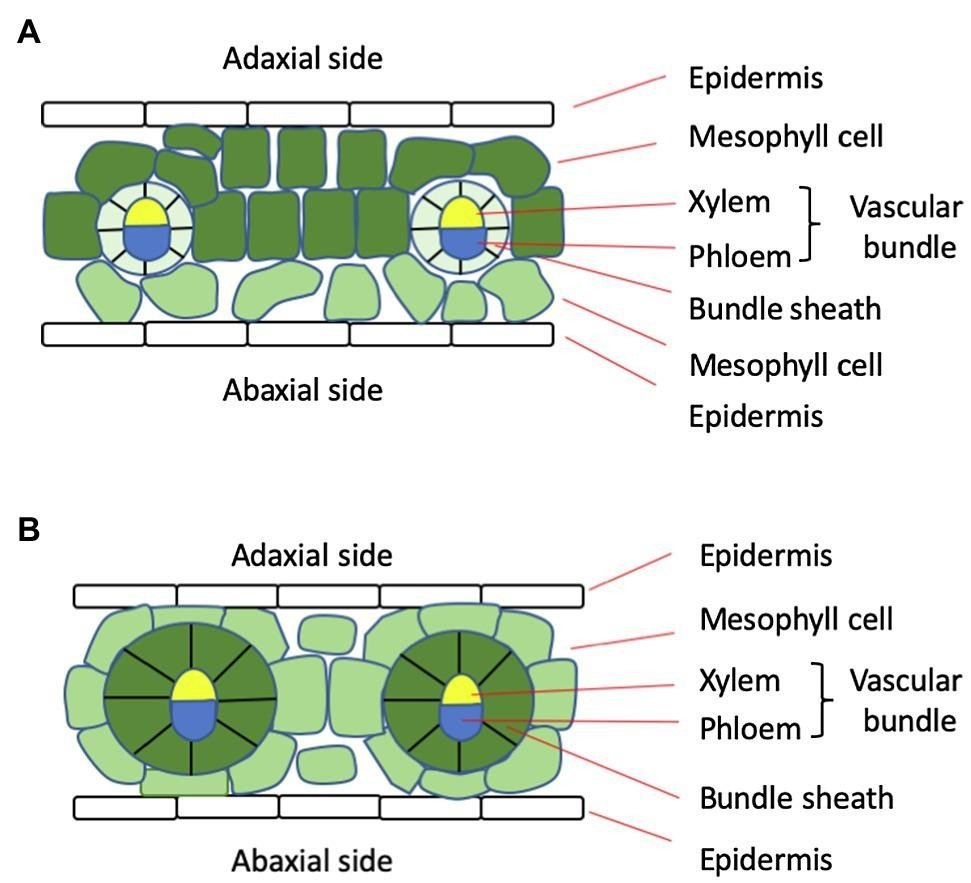
C4 plants possess a unique leaf structure known as Kranz anatomy (German word for “wreath”). This structure plays a critical role in separating initial CO₂ fixation from the Calvin cycle.
Key Features:
- Mesophyll cells form a ring around bundle sheath cells.
- Bundle sheath cells surround vascular bundles.
- Mesophyll chloroplasts contain well-developed grana.
- Bundle sheath chloroplasts lack grana and specialize in the Calvin cycle.
This spatial separation ensures a high CO₂ concentration near RuBisCO, preventing oxygen interference.
Steps of the C4 Pathway
The C4 pathway operates through a coordinated sequence of biochemical reactions:
- Step 1: CO₂ Uptake in Mesophyll Cells.
- Step 2: Formation of C4 Acids.
- Step 3: Transport to Bundle Sheath Cells.
- Step 4: Decarboxylation.
- Step 5: Calvin Cycle.
- Step 6: Regeneration of PEP.
Step 1: CO₂ Uptake in Mesophyll Cells
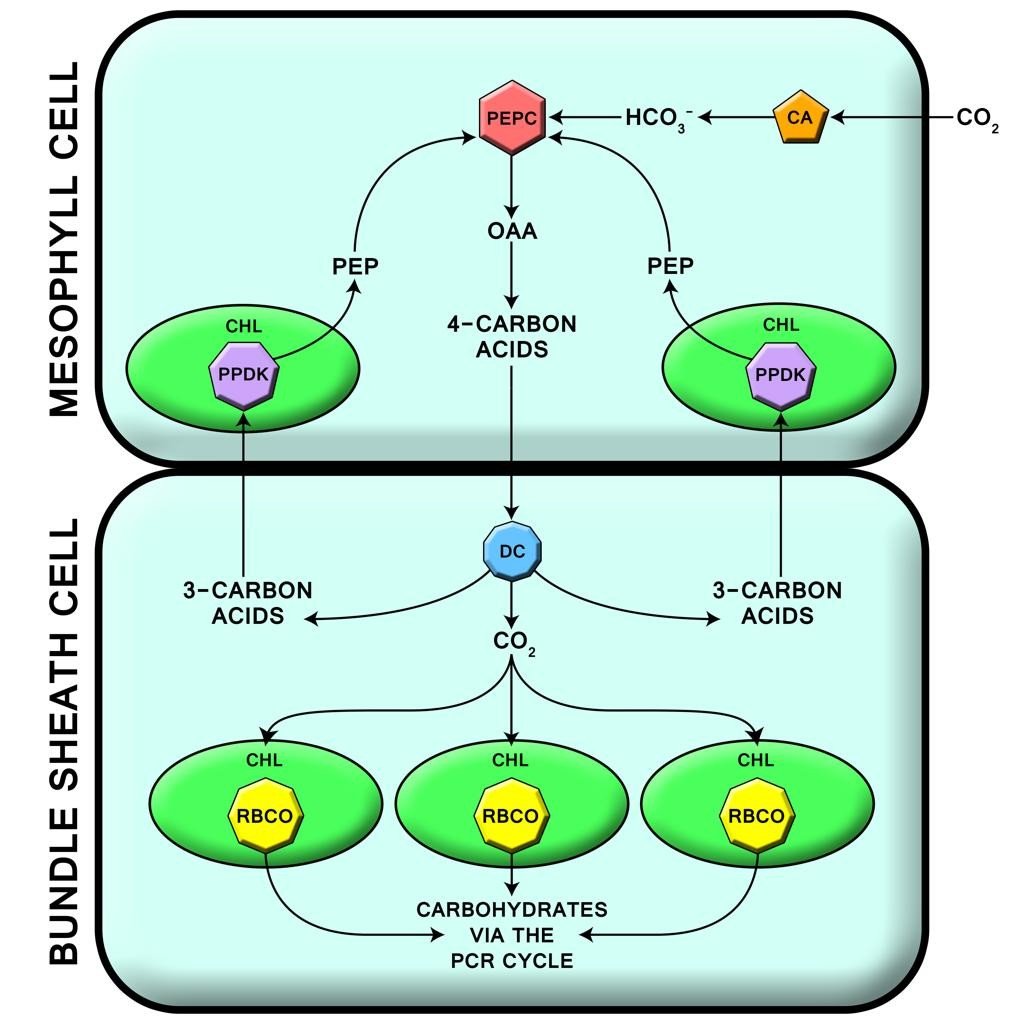
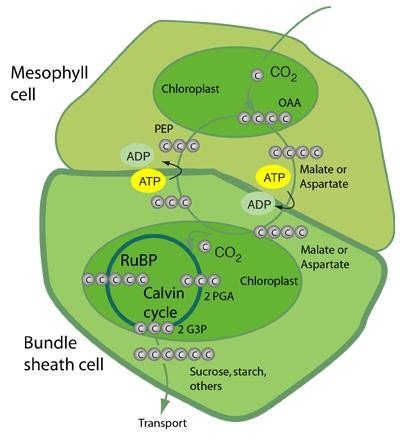
- Plants absorb CO₂ from the atmosphere. The enzyme carbonic anhydrase converts CO₂ into bicarbonate (HCO₃⁻).
- Then, PEP carboxylase (PEPC) fixes bicarbonate with phosphoenolpyruvate (PEP) to form oxaloacetate (OAA).
Key advantage:
- PEPC has a high affinity for CO₂ and does not interact with oxygen.
Step 2: Formation of C4 Acids
One of the four primary 4-carbon acids into which OAA is transformed:
- Either malate (via malate dehydrogenase) or
- Aspartate (through transaminase).
CO₂ is carried by these C₄ acids.
Step 3: Transport to Bundle Sheath Cells
- Through plasmodesmata, malate or aspartate is carried from the mesophyll to the bundle sheath cells.
- Depending on the species, these substances enter either the chloroplasts or the mitochondria of bundle sheath cells.
Step 4: Decarboxylation
Inside bundle sheath cells:
- Malate/aspartate releases CO₂.
- CO₂ concentration increases around RuBisCO.
- A 3-carbon compound (pyruvate or alanine) forms.
This step prevents photorespiration.
Step 5: Calvin Cycle
- The Calvin cycle is where the released CO2 enters.
- Because there is little O2 in bundle sheath cells, RuBisCO is able to fix CO2 effectively.
- Produces 3-phosphoglycerate, which then turns into glucose and other sugars.
Step 6: Regeneration of PEP
- Pyruvate returns to mesophyll cells.
The enzyme pyruvate phosphate dikinase (PPDK) regenerates PEP:
- Pyruvate + ATP + Pi → PEP
- This step consumes ATP, making the C4 pathway more energy-intensive.
Biochemical Subtypes of C4 Plants
C4 plants show variation based on the enzyme used for decarboxylation:
1. NADP-Malic Enzyme (NADP-ME) Type
- Decarboxylation occurs in chloroplasts.
- Malate acts as the transport molecule.
- Examples: maize, sugarcane.
2. NAD-Malic Enzyme (NAD-ME) Type
- Decarboxylation occurs in mitochondria.
- Aspartate is the primary transport molecule.
- Found in some grasses.
3. PEP Carboxykinase (PEP-CK) Type
- Decarboxylation occurs in cytoplasm.
- Requires additional ATP.
- Found in some millets.
- Many plants use a combination of these pathways depending on environmental conditions.
Energy Requirement of the C4 Pathway
The C4 pathway requires more ATP than the C3 pathway due to:
- Regeneration of PEP.
- Transport of metabolites between cells.
Energy Cost:
- C3 pathway: 3 ATP per CO₂.
- C4 pathway: 5 ATP per CO₂.
Despite this higher energy requirement, C4 plants achieve:
- Higher photosynthetic efficiency.
- Reduced photorespiration.
- Better performance under stress.
Ecological and Evolutionary Significance
C4 photosynthesis evolved independently in multiple plant lineages. It provides several ecological advantages:
- High water-use efficiency
- Improved nitrogen-use efficiency
- Rapid growth in high light conditions
- Dominance in tropical grasslands and savannas
Common C4 Plants:
- Maize
- Sugarcane
- Sorghum
- Millets
- Amaranthus
- Tropical grasses
These plants contribute significantly to global food production and ecosystems.
Applications of the C4 Pathway
1. Increased Agricultural Productivity
- In particular, in hot and sunny environments, C4 plants are more efficient at photosynthesis.
- They have a higher output of biomass and a higher yield than many C₃ plants.
- Examples include sorghum, maize, millets, and sugarcane, which are all important industrial and food crops.
2. Increased Drought Resistance
- Due to their capacity to maintain a partially closed stomata while still efficiently fixing CO₂, C4 plants lose less water.
- Because of this, they are perfect for semi-arid and dry climates.
- Aids farmers in lowering their irrigation needs.
3. Improved Nitrogen Usage Efficiency
- Because they need less RuBisCO, C4 plants use less nitrogen during photosynthesis.
- Lowers reliance on nitrogen fertilizers.
- Promotes sustainable agriculture.
4. Enhanced performance at elevated temperatures
- Unlike C3 plants, C4 photosynthesis doesn’t decline significantly at high temperatures.
- Appropriate for subtropical and tropical farming.
- Climate change resilience: Warmer climates will favor C4 plants.
5. Improved Carbon Sequestration
- Grasses in the C4 family grow quickly and have extensive root systems.
- They sequester and retain more CO2 in soil and biomass.
- Helpful for initiatives aimed at climate change mitigation, soil rehabilitation, and carbon farming.
6. Manufacturing Biofuel
- Sugarcane and maize are two of the most important C4 plants, and they provide a significant amount of:
- Bioethanol
- Biogas
- Bio-based substances
- They are perfect for the biofuel sector due to their biomass and high sugar production.
7. Used in genetic engineering and reproduction
- Researchers are attempting to modify C₃ crops into resembling C₄ plants by studying the C₄ pathway, particularly:
- Rice
- Wheat
- Objective: increase stress resistance and production.
- The anatomy and genes of the C4 pathway are models for enhancing crops.
8. Benefits of Ecological Adaptation
- Warm grasslands, savannas, and open environments are mostly dominated by C₄ plants.
- They contribute to maintaining ecosystems by:
- Quick expansion.
- Significant biomass output.
- Resistance to drought.
9. Soil stabilization
- The following are some uses for C4 grasses:
- Initiatives to protect the soil.
- Putting a stop to erosion.
- The process of reclaiming land.
- Their extensive roots stabilize soil and enhance its structure.
Advantages of the C4 Pathway
- Minimizes photorespiration.
- Enhances photosynthetic efficiency.
- Improves water-use efficiency.
- Supports high productivity.
- Increases stress tolerance.
Limitations of the C4 Pathway
- Requires more ATP.
- Complex anatomical structure.
- Limited to specific plant species.
Conclusion
The C4 pathway represents a highly efficient photosynthetic adaptation that allows plants to thrive under harsh environmental conditions such as high temperatures, drought, and low CO₂ levels. By using a specialized Kranz anatomy and a CO₂-concentrating mechanism, C4 plants minimize photorespiration and maximize carbon fixation.
Although the pathway requires additional ATP, the benefits far outweigh the energy cost. C4 plants demonstrate higher productivity, better water and nitrogen efficiency, and greater resilience to environmental stress. These features make them essential for global agriculture, climate adaptation, and sustainable development.
As climate change continues to impact crop productivity, understanding and applying the principles of the C4 pathway will play a crucial role in improving future food security and ecosystem stability.
Frequently Asked Questions (FAQ)
Q1. What is the C4 pathway?
The C4 pathway is a photosynthetic process in which plants fix CO₂ into a four-carbon compound before entering the Calvin cycle.
Q2. Why is the C4 pathway important?
It reduces photorespiration and increases photosynthetic efficiency, especially in hot and dry environments.
Q3. What is Kranz anatomy?
Kranz anatomy is a specialized leaf structure in C4 plants where mesophyll cells surround bundle sheath cells.
Q4. Name some C4 plants.
Examples include maize, sugarcane, sorghum, millets, and Amaranthus.
Q5. Does the C4 pathway require more energy?
Yes, it requires more ATP than the C3 pathway but provides higher efficiency.
Q6. Where does the Calvin cycle occur in C4 plants?
It occurs in the bundle sheath cells.
Q7. What enzyme fixes CO₂ in the C4 pathway?
PEP carboxylase (PEPC) initially fixes CO₂.
Q8. What is the first stable product in the C4 cycle?
Oxaloacetate (OAA), a 4-carbon compound.
Reference and Sources
- https://www.geeksforgeeks.org/biology/c3-and-c4-photosynthetic-pathways/
- https://www.britannica.com/science/photosynthesis/Carbon-fixation-in-C4-plants
- https://pmc.ncbi.nlm.nih.gov/articles/PMC3075750/
- https://www.geeksforgeeks.org/biology/c4-cycle-of-photosynthesis/
- https://www.biologydiscussion.com/photosynthesis/hatch-slack-c4-pathway-of-co2-fixation/51623
- https://pmc.ncbi.nlm.nih.gov/articles/PMC158949/
Also Read
- C3 Pathway (Calvin–Benson Cycle): Complete Explanation
- Multiple Sclerosis: Introduction, Symptoms, Causes and Diagnosis
- Agriculture microbiology: Introduction, Function and interaction
- Different types of Pathways for ATP Production
- Dodder: Introduction, Development of Disease, Symptoms and Control
- Overview of Glucose Catabolism via Glycolysis
