Introduction to Next-Generation DNA Sequencing
- Next-generation DNA sequencing (NGS) is an advanced DNA sequencing technology that enables millions of DNA fragments to be sequenced simultaneously. Also known as massively parallel sequencing, NGS has transformed genomics by making DNA sequencing faster, more scalable, and generally more cost-effective than traditional Sanger sequencing for large-scale projects.
- DNA sequencing is the process of determining the precise order of nucleotides in a DNA molecule. The four nucleotides are adenine (A), thymine (T), guanine (G), and cytosine (C). Determining their sequence helps scientists understand genetic information, identify mutations, study microorganisms, investigate infectious diseases, and analyze entire genomes.
- Traditional Sanger sequencing played a crucial role in early genome sequencing projects. However, sequencing large genomes using conventional methods was expensive and time-consuming. The development of next-generation sequencing technologies made it possible to analyze enormous amounts of genetic information in a single sequencing run.
- Today, NGS is widely used in microbiology, molecular biology, clinical research, cancer genomics, metagenomics, evolutionary biology, and biotechnology.
What Is Next-Generation DNA Sequencing?
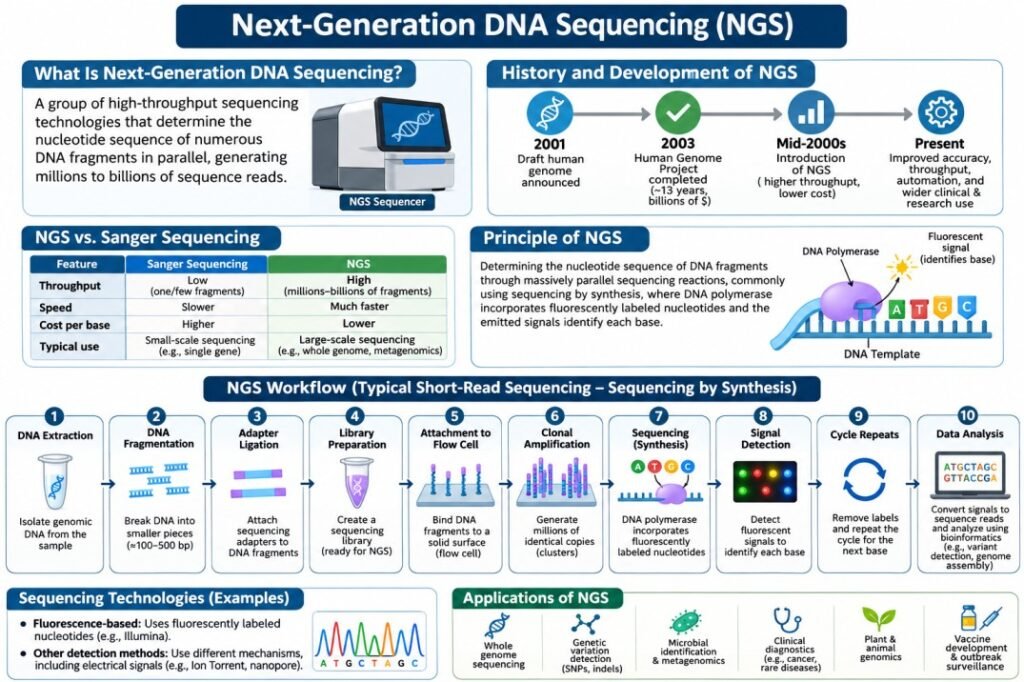
- Next-generation DNA sequencing is a group of high-throughput sequencing technologies that determine the nucleotide sequences of numerous DNA fragments in parallel.
- Unlike traditional Sanger sequencing, which generally analyzes individual DNA fragments separately, NGS technologies process large numbers of DNA fragments simultaneously. This parallel processing enables researchers to generate millions to billions of sequence reads, depending on the sequencing platform and experimental configuration.
- Most short-read NGS workflows involve DNA fragmentation, adapter ligation, library preparation, amplification or template generation, sequencing, and computational analysis.
- Some sequencing technologies use fluorescently labeled nucleotides to identify the bases incorporated into newly synthesized DNA strands. Other platforms use different detection mechanisms, including electrical signals.
History and Development of Next-Generation Sequencing
- The development of next-generation sequencing was driven by the need to sequence DNA more rapidly and economically.
- The Human Genome Project produced a landmark reference sequence, with its initial draft announced in 2001 and the project declared complete in 2003. The original international project required approximately 13 years and billions of dollars in funding.
- These early efforts demonstrated the scientific importance of genome sequencing but also highlighted the need for higher-throughput technologies.
- The introduction of next-generation sequencing platforms in the mid-2000s substantially increased sequencing throughput and reduced the cost per base.
- Over time, improvements in sequencing chemistry, instrumentation, library preparation, and bioinformatics have expanded the use of NGS across research and clinical applications.
- Modern sequencing technologies continue to improve read accuracy, throughput, automation, and the ability to analyze complex genomes.
Principle of Next-Generation DNA Sequencing
- The principle of next-generation DNA sequencing depends on determining the nucleotide sequence of DNA fragments through massively parallel sequencing reactions.
- In a commonly used short-read sequencing approach, known as sequencing by synthesis, DNA polymerase incorporates nucleotides complementary to a template strand. Modified nucleotides generate detectable fluorescent signals during incorporation, allowing the identity of each base to be determined.
The process generally involves the following steps:
- Genomic DNA is extracted from the sample.
- DNA is fragmented into smaller pieces.
- Sequencing adapters are attached to the DNA fragments.
- The prepared DNA fragments are attached to a solid surface within a flow cell.
- Clonal amplification generates clusters of DNA fragments.
- DNA polymerase incorporates complementary nucleotides.
- Fluorescent signals are detected to identify the incorporated bases.
- The fluorescent labels and reversible blocking groups are removed.
- The sequencing cycle is repeated.
- Computational analysis converts the signals into nucleotide sequences.
The resulting sequences, called reads, are analyzed using bioinformatics tools to identify genetic variations, assemble genomes, or compare sequences with reference databases.
Note: This workflow describes a widely used short-read sequencing-by-synthesis approach. Not all next-generation sequencing platforms use the same chemistry or amplification procedure.
Steps of Next-Generation DNA Sequencing
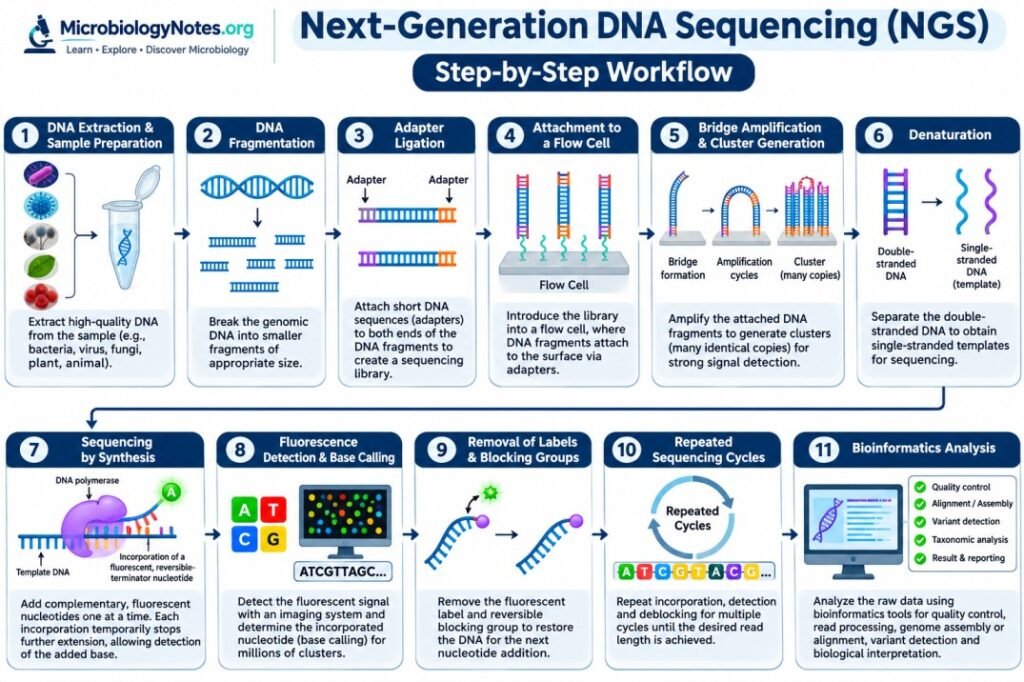
Step 1: DNA Extraction and Sample Preparation
- The first step in NGS is extracting DNA from the biological sample.
- Depending on the research objective, the sample may contain DNA from human cells, bacteria, viruses, fungi, plants, animals, or environmental microbial communities.
- DNA extraction must produce sufficient quantity and quality for library preparation. Contaminants such as proteins, salts, and residual extraction reagents can interfere with downstream reactions.
- DNA concentration, purity, and integrity may be assessed before sequencing.
- For microbial whole-genome sequencing, appropriate sample preparation is especially important because contamination or poor DNA quality can affect genome coverage and data interpretation.
Step 2: DNA Fragmentation
- The extracted genomic DNA is broken into smaller fragments suitable for the selected sequencing platform.
- Fragmentation may be performed mechanically, enzymatically, or through other platform-specific methods.
- The appropriate fragment size depends on the sequencing technology, library preparation protocol, and experimental objective.
- Short-read sequencing commonly analyzes relatively short DNA fragments, whereas long-read sequencing platforms can analyze much longer DNA molecules.
- Fragmentation allows large genomes to be processed efficiently by sequencing many smaller DNA regions in parallel.
Step 3: Adapter Ligation
- Short DNA sequences called adapters are attached to the ends of DNA fragments during library preparation.
- Adapters contain sequences required for downstream processing, such as amplification, attachment to the sequencing surface, and sequencing-primer binding.
- Depending on the platform and protocol, adapters may also contain index sequences, which help distinguish different samples processed together in the same sequencing run.
- The collection of prepared DNA fragments is called a sequencing library.
- Proper library preparation is essential because adapter-related problems, contamination, and uneven fragment representation can reduce sequencing efficiency and data quality.
Step 4: Attachment of DNA Fragments to a Flow Cell
- In a commonly used sequencing-by-synthesis workflow, the prepared DNA library is introduced into a flow cell.
- A flow cell is a specialized surface or chamber that allows sequencing reagents to be delivered and removed while DNA templates remain attached to the sequencing surface.
- Adapters or complementary oligonucleotides on the surface facilitate the attachment of DNA fragments.
- The flow cell supports the organization and processing of a large number of DNA templates during sequencing.
- Not all NGS technologies use flow cells; the exact configuration depends on the sequencing platform.
Step 5: Bridge Amplification and Cluster Generation
- In flow-cell-based short-read sequencing systems that use bridge amplification, attached DNA fragments bend toward nearby surface-bound oligonucleotides.
- The adapter at the free end of a fragment hybridizes to a complementary oligonucleotide on the surface. DNA polymerase then synthesizes a complementary strand.
- The resulting double-stranded DNA is denatured, leaving single-stranded templates attached to the surface.
- Repeated amplification cycles generate clusters containing many copies of the same original DNA fragment.
- These clusters produce sufficiently strong signals for optical detection during sequencing.
- Cluster generation is important because the fluorescent signal from an individual nucleotide is generally too weak for reliable detection in this sequencing configuration.
- Key point: Bridge amplification is used by certain short-read sequencing platforms, particularly established Illumina workflows. Other NGS platforms may use different template preparation and amplification strategies.
Step 6: Denaturation of Double-Stranded DNA
- Following cluster generation, double-stranded DNA is denatured to produce single-stranded templates for sequencing.
- The appropriate strand is retained or prepared according to the sequencing protocol, and the flow cell is conditioned for the sequencing reaction.
- Single-stranded DNA provides the template that DNA polymerase reads while synthesizing a complementary strand.
Step 7: Sequencing by Synthesis
- Sequencing by synthesis is a widely used method for determining DNA sequences.
- In reversible-terminator sequencing, DNA polymerase incorporates a complementary, chemically modified nucleotide into the growing DNA strand.
- Each nucleotide type is associated with a detectable fluorescent signal. The chemical modification temporarily prevents further nucleotide incorporation after one base has been added.
- This temporary termination allows the instrument to identify the incorporated nucleotide before the next sequencing cycle begins.
- Unlike conventional Sanger sequencing, which uses chain-terminating dideoxynucleotides to generate terminated DNA fragments, reversible-terminator sequencing uses modified nucleotides designed to permit repeated cycles of incorporation and deblocking.
Step 8: Fluorescence Detection and Base Calling
- After nucleotide incorporation, the sequencing instrument detects the fluorescent signal associated with the newly incorporated base.
- The signal is recorded using optical detection systems, and the instrument determines which nucleotide was added at each position.
- This computational identification of nucleotides is called base calling.
- The process is repeated across millions of clusters, generating large numbers of sequence reads.
- The quality of the signal, the synchronization of cluster extension, and the sequencing chemistry all influence the accuracy of the resulting data.
Step 9: Removal of Fluorescent Labels and Blocking Groups
- After each sequencing cycle, the fluorescent label and reversible blocking group are chemically or enzymatically removed according to the platform’s chemistry.
- This step restores the chemical group required for the next nucleotide incorporation.
- Once the sequencing surface is ready, another cycle of nucleotide incorporation and signal detection can begin.
- The repeated cycles allow the instrument to determine the sequence of the growing complementary DNA strands one base at a time.
Step 10: Repeated Sequencing Cycles
- The incorporation, signal detection, and deblocking steps are repeated until the intended read length is reached.
- During each cycle, the instrument records the identity of the incorporated nucleotide for each cluster.
- In some short-read sequencing workflows, read lengths commonly fall within approximately 150–300 bases, although actual read lengths vary by platform and protocol.
- As the number of cycles increases, some DNA molecules within a cluster may become out of synchronization. This effect, together with other technical factors, can reduce signal quality and affect base-calling accuracy.
- Paired-end sequencing can read DNA fragments from both ends, providing additional information that can improve genome assembly and sequence alignment.
Step 11: Bioinformatics Analysis
- The final step is converting the raw sequencing output into biologically meaningful information.
- Bioinformatics analysis typically involves:
- Base calling and quality assessment.
- Adapter trimming and quality filtering.
- Alignment of reads to a reference genome or transcriptome, when appropriate.
- De novo genome assembly when a suitable reference is unavailable.
- Variant detection and interpretation.
- Taxonomic identification and microbial community analysis, where relevant.
- Generation of quality-control reports.
- The analytical workflow depends on the research question.
- For example, bacterial whole-genome sequencing may be used to identify a microorganism, examine genetic relationships between isolates, or investigate genes associated with antimicrobial resistance.
- Metagenomic sequencing, on the other hand, can be used to study the genetic material of multiple organisms present in a sample.
What Is Sequencing by Synthesis?
- Sequencing by synthesis (SBS) is a DNA sequencing method in which the sequence of a template is determined by monitoring nucleotide incorporation during the synthesis of a complementary DNA strand.
- In reversible-terminator SBS, modified nucleotides contain a reversible blocking group and a detectable label.
The process follows these basic stages:
- DNA polymerase incorporates a complementary modified nucleotide.
- A detectable fluorescent signal identifies the incorporated nucleotide.
- The instrument records the signal and determines the base.
- The fluorescent label and blocking group are removed.
- DNA synthesis continues during the next cycle.
- This cycle-by-cycle approach enables the sequencing instrument to determine DNA sequences across large numbers of templates in parallel.
- SBS is particularly important in widely used short-read sequencing platforms.
- However, it is not the only NGS sequencing chemistry. Other technologies use different methods to detect nucleotide incorporation or sequence DNA molecules.
What Is Bridge Amplification in NGS?
- Bridge amplification is a clonal amplification technique used in certain flow-cell-based sequencing systems.
- During this process, a DNA fragment attached to a surface bends over and hybridizes to a nearby complementary oligonucleotide. DNA polymerase synthesizes a new strand, creating a bridge-shaped DNA structure.
- Repeated denaturation and synthesis cycles generate a cluster of DNA molecules derived from the original fragment.
- The main purpose of bridge amplification is to produce enough copies of a DNA template in a localized area to generate a detectable sequencing signal.
- Bridge amplification supports high-throughput sequencing by creating many spatially separated clusters on the same flow cell.
- It is important to distinguish bridge amplification from emulsion PCR, which is used in some other sequencing workflows. Both can amplify DNA templates, but they differ in how the amplification reactions are organized.
Types of Next-Generation DNA Sequencing Technologies
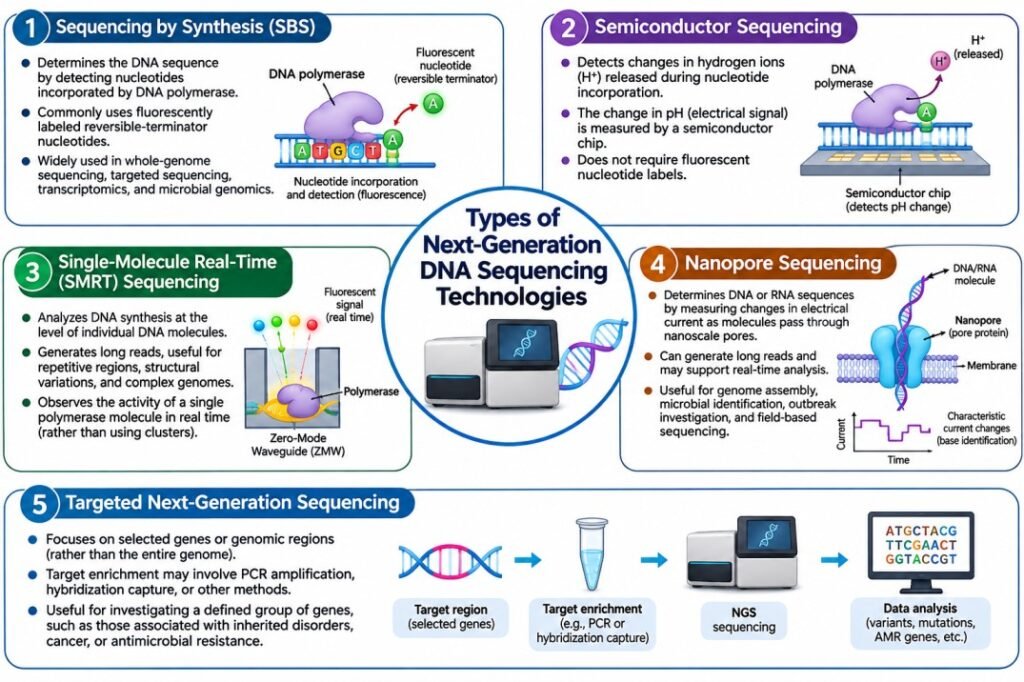
NGS includes several sequencing approaches that differ in chemistry, read length, signal detection, throughput, and data analysis.
1. Sequencing by Synthesis
- Sequencing by synthesis determines the sequence of DNA by detecting nucleotides incorporated by DNA polymerase.
- Many short-read sequencing systems use fluorescently labeled reversible-terminator nucleotides.
- This approach is widely used in whole-genome sequencing, targeted sequencing, transcriptomics, and microbial genomics.
2. Semiconductor Sequencing
- Semiconductor sequencing detects changes associated with hydrogen ions released during nucleotide incorporation.
- These changes produce a measurable signal that can be used to identify the incorporated nucleotide.
- Unlike fluorescence-based methods, semiconductor sequencing does not require optical detection of fluorescent nucleotide labels.
3. Single-Molecule Real-Time Sequencing
- Single-molecule real-time (SMRT) sequencing analyzes DNA synthesis at the level of individual DNA molecules.
- It can generate long reads that are useful for resolving repetitive regions, structural variations, and complex genome assemblies.
- SMRT sequencing differs from conventional short-read sequencing because it observes the activity of individual polymerase molecules rather than relying on large clusters of identical templates.
4. Nanopore Sequencing
- Nanopore sequencing determines DNA or RNA sequences by measuring characteristic changes in electrical current as molecules pass through nanoscale pores.
- It can generate long reads and, depending on the platform and experimental setup, may support real-time analysis.
- Nanopore sequencing is useful for genome assembly, microbial identification, outbreak investigation, and field-based sequencing applications.
5. Targeted Next-Generation Sequencing
- Targeted NGS focuses on selected genes or genomic regions rather than sequencing an entire genome.
- Target enrichment may involve PCR amplification, hybridization capture, or other methods.
- Targeted sequencing can be useful when researchers need to investigate a defined group of genes, such as genes associated with inherited disorders, cancer, or antimicrobial resistance.
Next-Generation Sequencing vs. Sanger Sequencing
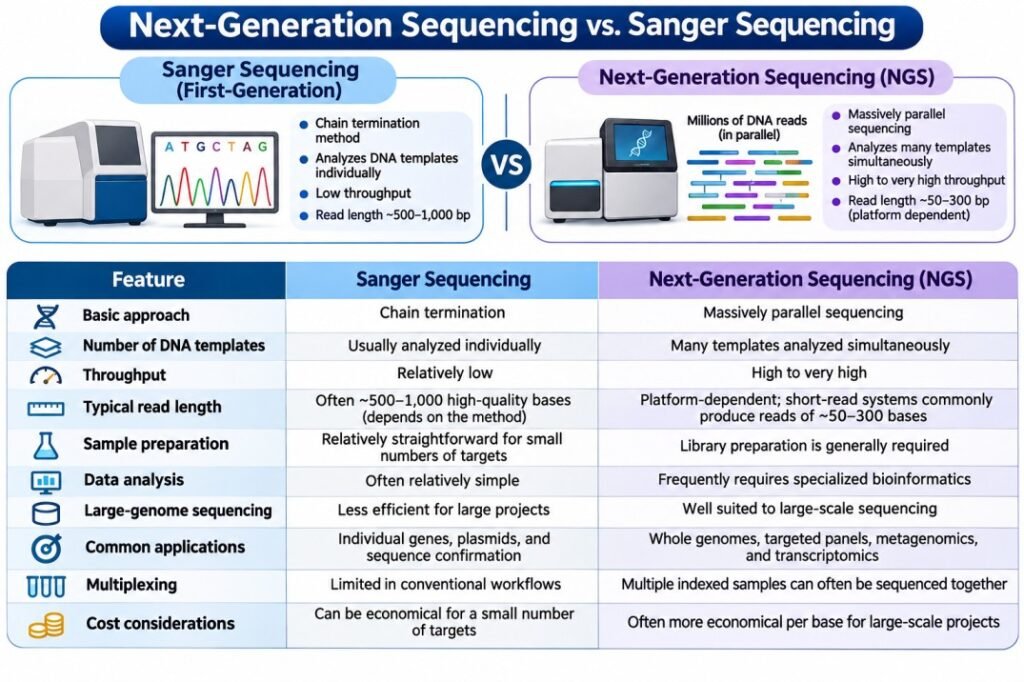
| Feature | Sanger Sequencing | Next-Generation Sequencing |
| Basic approach | Chain termination | Massively parallel sequencing |
| Number of DNA templates | Usually analyzed individually | Many templates analyzed simultaneously |
| Throughput | Relatively low | High to very high |
| Typical read length | Often approximately 500–1,000 high-quality bases, depending on the method | Platform-dependent; short-read systems commonly produce reads of approximately 50–300 bases |
| Sample preparation | Relatively straightforward for small numbers of targets | Library preparation is generally required |
| Data analysis | Often relatively simple | Frequently requires specialized bioinformatics |
| Large-genome sequencing | Less efficient for large projects | Well suited to large-scale sequencing |
| Common applications | Individual genes, plasmids, and sequence confirmation | Whole genomes, targeted panels, metagenomics, and transcriptomics |
| Multiplexing | Limited in conventional workflows | Multiple indexed samples can often be sequenced together |
| Cost considerations | Can be economical for a small number of targets | Often more economical per base for large-scale projects |
Advantages of Next-Generation DNA Sequencing
- NGS can analyze millions of DNA fragments simultaneously, making it suitable for large-scale genomic investigations.
- Sequencing instruments and workflows can require substantial investment, NGS can reduce the cost per nucleotide when large amounts of DNA are sequenced.
- NGS can generate enormous quantities of sequence data in a single run, reducing the time needed for many genome-scale projects compared with conventional approaches.
- Many NGS workflows do not require individual DNA fragments to be cloned into vectors before sequencing. This simplifies the analysis of large and complex genomic libraries.
- Sample-specific index sequences can allow multiple samples to be pooled and sequenced in a single run.
- Multiplexing can improve sequencing efficiency and reduce the cost per sample, provided that the sequencing capacity is appropriate for the combined samples.
- NGS can identify many types of genetic differences, including single-nucleotide variants, small insertions and deletions, and, with appropriate methods, larger structural variations.
- NGS enables researchers to characterize bacterial, viral, fungal, and mixed microbial populations.
Limitations of Next-Generation DNA Sequencing
- NGS generates large datasets that require computational tools, appropriate reference databases, and skilled interpretation.
- Short-read sequencing may struggle to resolve repetitive genomic regions, complex structural variations, and certain genomic arrangements. Long-read sequencing can help address these challenges.
- DNA extraction, fragmentation, adapter ligation, amplification, and enrichment can introduce biases that affect which sequences are represented in the final library.
- Errors may arise from sequencing chemistry, signal detection, amplification, base calling, or sample contamination. Quality-control procedures and appropriate analytical methods are essential for reliable results.
- High-throughput sequencing can require specialized equipment, laboratory infrastructure, computing resources, and trained personnel.
Detecting a genetic difference does not automatically establish its biological or clinical significance. Results must be interpreted in the context of the sample, experimental design, reference data, and research question.
Applications of Next-Generation DNA Sequencing
NGS is used across many scientific and medical fields.
1. Whole-Genome Sequencing
- Whole-genome sequencing analyzes DNA across an organism’s genome. In microbiology, bacterial whole-genome sequencing can support species characterization, strain comparison, outbreak investigation, and the study of antimicrobial resistance.
2. Metagenomics
- Metagenomic sequencing examines genetic material recovered directly from a sample containing multiple organisms.
- It can help researchers investigate microbial diversity in soil, water, wastewater, food, and other environmental or biological samples.
- Depending on the method, metagenomics can identify organisms that are difficult to culture using conventional laboratory techniques.
3. Clinical Genomics
- NGS can be used in appropriately validated clinical tests to investigate genetic variants associated with inherited diseases and other medical conditions.
- Clinical interpretation requires suitable validation, quality assurance, and compliance with applicable regulatory requirements.
4. Cancer Research
- Cancer genomics uses sequencing to investigate mutations and other genomic alterations associated with tumor development and progression.
- Some validated genomic tests also help clinicians select treatment options for particular cancers.
5. Infectious Disease Investigation
- NGS can support the characterization of infectious agents, analysis of transmission patterns, and investigation of outbreaks.
- The value of the results depends on sample quality, sequencing coverage, analytical methods, and the availability of suitable reference data.
6. Antimicrobial Resistance Research
- Microbial genome sequencing can identify genetic markers associated with antimicrobial resistance.
- However, detecting a resistance-associated gene or mutation does not always predict the complete susceptibility profile of an isolate. Genomic findings may need to be interpreted alongside phenotypic antimicrobial susceptibility testing.
7. Transcriptomics
- RNA sequencing, commonly called RNA-seq, analyzes RNA-derived sequences to investigate gene expression and transcript diversity.
- RNA is generally converted into complementary DNA before sequencing in conventional RNA-seq workflows.
8. Evolutionary Biology
- Researchers use NGS to compare genetic sequences among organisms, investigate evolutionary relationships, and study population-level genetic diversity.
9. Food and Environmental Microbiology
- NGS can help characterize microbial communities in food products, processing environments, soil, and water.
- It can support microbial diversity studies, contamination investigations, and research into microbial ecology.
Importance of NGS in Microbiology
Next-generation sequencing has expanded the ability of microbiologists to study microorganisms at the genomic level.
Traditional microbiological methods remain essential for culture, isolation, enumeration, identification, and phenotypic characterization. NGS provides additional information about microbial genomes and communities that may not be available through routine culture-based methods alone.
Important applications include:
- Bacterial and fungal whole-genome sequencing.
- Viral genome characterization.
- Identification of genetic determinants of antimicrobial resistance.
- Microbial strain typing and epidemiological investigations.
- Analysis of complex microbial communities.
- Environmental and food microbiome studies.
- Investigation of microbial evolution and genetic diversity.
For example, two bacterial isolates may appear similar in routine laboratory tests but show meaningful genomic differences when analyzed using whole-genome sequencing.
Conversely, genomic similarity does not by itself prove that two isolates share a direct transmission link. Epidemiological information and appropriate analytical methods are also necessary.
How Much Data Can NGS Generate?
- NGS output varies considerably by sequencing platform, instrument configuration, flow cell, run duration, read length, and experimental design.
- Modern high-throughput systems can generate millions to billions of reads during a sequencing run.
- For illustration, a dataset containing 1 billion bases corresponds to approximately 1 gigabase (1 Gb) of sequence data. A gigabase describes the number of nucleotide bases, not the file size in gigabytes.
- This distinction is important because sequencing data files can occupy substantially more storage than the raw number of bases alone would suggest.
- For a bacterial genome of approximately 4 million base pairs, a theoretical total of 40 million sequenced bases corresponds to 10-fold coverage of the genome, assuming uniform representation and ignoring data losses and mapping complications.
- Actual sequencing requirements depend on the desired coverage, genome complexity, quality thresholds, and analytical objective.
Future of Next-Generation DNA Sequencing
Sequencing technologies continue to evolve as researchers seek higher throughput, improved accuracy, longer reads, lower costs, and simpler workflows.
Important areas of development include:
- Improved library preparation and automation.
- Longer and more accurate reads.
- Better resolution of repetitive and structurally complex genomic regions.
- Real-time sequencing and data analysis.
- More efficient bioinformatics pipelines.
- Improved detection of rare genetic variants.
- Integration of genomic data with other biological measurements.
Short-read and long-read technologies offer complementary capabilities. The most appropriate technology depends on the biological question rather than on a single measure of sequencing performance.
As sequencing becomes more accessible, NGS is expected to remain an important tool in microbiology, biotechnology, medicine, and genomic research.
Conclusion
Next-generation DNA sequencing is a high-throughput approach that allows researchers to determine the sequences of numerous DNA fragments simultaneously. By combining library preparation, template generation, sequencing chemistry, signal detection, and bioinformatics, NGS enables large-scale analysis of genetic information.
Sequencing by synthesis and bridge amplification are important components of widely used short-read sequencing workflows, although other NGS platforms use different approaches.
Compared with conventional Sanger sequencing, NGS is particularly advantageous for large genomic projects, microbial genomics, metagenomics, and the investigation of genetic variation. Its limitations, including data complexity, platform-dependent read lengths, and the need for careful quality control, must also be considered.
Understanding the principles and workflow of NGS is essential for students, microbiologists, molecular biologists, and researchers working with modern genomic technologies.
Frequently Asked Questions About Next-Generation Sequencing
Q1. What is the difference between short-read and long-read sequencing?
Short-read sequencing generates relatively short DNA sequences and is often effective for high-throughput genome analysis. Long-read sequencing analyzes much longer DNA molecules, which can help resolve repetitive regions, structural variations, and complex genome assemblies.
Q2. What is bioinformatics in NGS?
Bioinformatics involves using computational methods to process, analyze, and interpret sequencing data. Typical tasks include quality assessment, read alignment, genome assembly, variant detection, and microbial taxonomic analysis.
Can NGS identify antimicrobial resistance genes?
Yes. NGS can identify genes and mutations associated with antimicrobial resistance. However, genomic findings must be interpreted carefully because the presence or absence of a particular marker does not always establish an organism’s complete antimicrobial susceptibility profile.
Reference and Sources
Also Read
- https://microbiologynotes.org/sanger-dna-sequencing-principle-steps-applications-and-limitations/
- https://microbiologynotes.org/molecular-detection-of-microorganisms-intro-molecular-methods-applications/
- https://microbiologynotes.org/methods-for-laboratory-diagnosis-of-viral-infections/
- https://microbiologynotes.org/microbial-identification-and-strain-typing-using-molecular-techniques/
- https://microbiologynotes.org/omicron-overview-transmissible-vaccination-and-severity-of-disease/
